
ReadyMadeApps
SaaS Business Model Explained: How SaaS Companies Make Money
Learn how the SaaS business model earns recurring revenue, which pricing models work, the metrics that matter, and how to validate a SaaS idea.
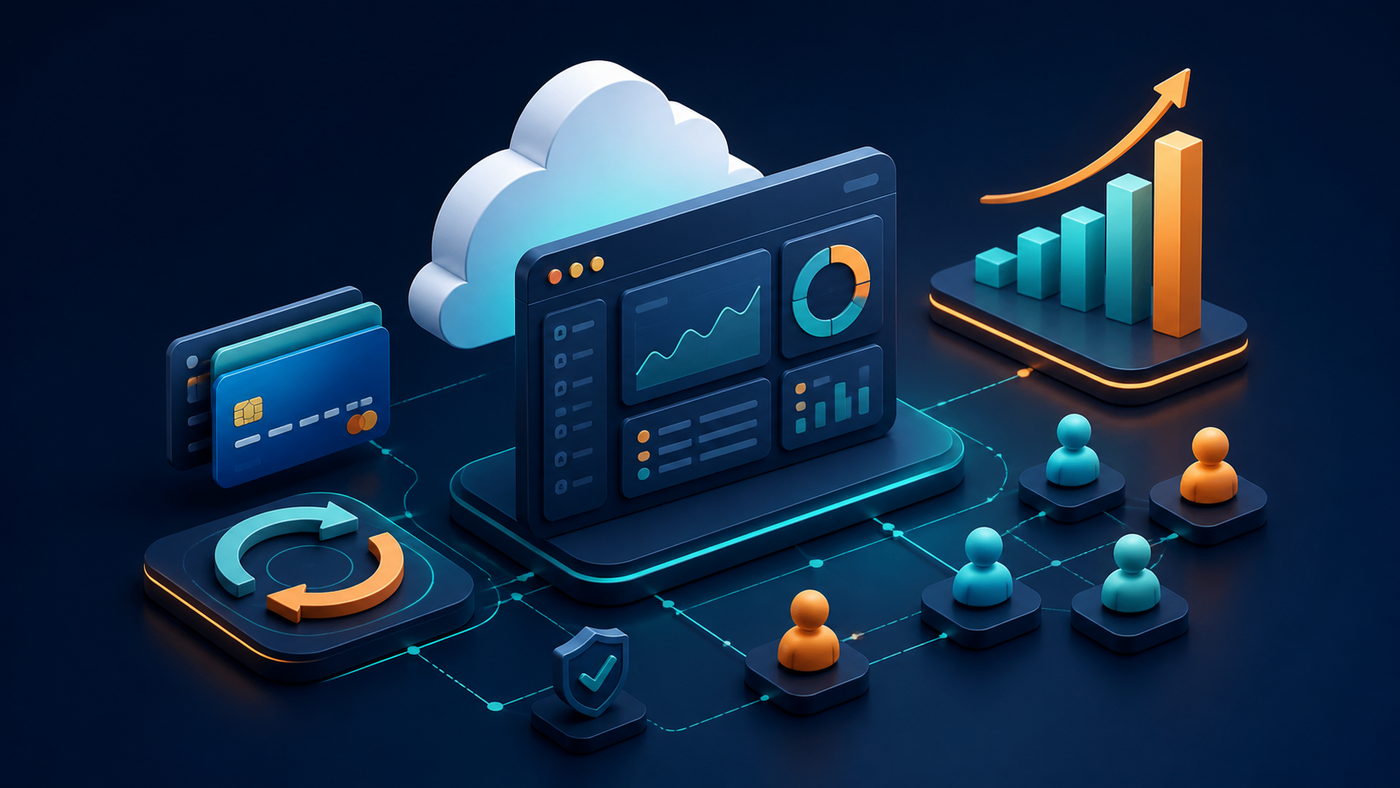
A SaaS business earns money by giving customers ongoing access to cloud-hosted software, usually through a recurring subscription or usage-based fee. The model can create predictable revenue, but only when the product keeps solving a real problem, customers stay, and acquisition and service costs remain under control.
What This Means for You
If you are evaluating a SaaS idea, building a micro-SaaS product, or considering a ready-made app business, do not focus on subscription revenue alone. Ask four practical questions: who has the painful problem, how quickly they reach value, why they will keep paying, and whether the gross profit from each customer comfortably covers acquisition, hosting, support, and product work.
The simplest useful mental model is a loop: acquire a suitable customer, activate them, deliver continuing value, collect recurring revenue, reinvest in the product, and retain or expand the account. A leak at any point weakens the entire business.

How the SaaS Business Model Works
Software as a service moves software from a one-time installed product to an ongoing service. The provider hosts the application, maintains it, secures it, ships updates, and gives customers access through a browser or app. Customers generally pay monthly or annually, although usage-based and hybrid pricing are increasingly common.
This creates a different operating rhythm from selling a download once. Revenue can recur, but the obligation also recurs. Every billing period is another decision point at which a customer can renew, downgrade, or leave.
The five-part SaaS engine
- Problem and audience: The product handles a specific job for a defined user, such as scheduling appointments, managing leads, or generating reports.
- Delivery: The application is hosted online and updated centrally, so users do not need to install every release.
- Monetization: The company charges for access, consumption, seats, features, or a combination.
- Retention: Onboarding, reliability, support, and product improvement keep customers receiving value.
- Expansion: More seats, higher tiers, add-ons, or increased usage can grow revenue from existing accounts.
That operating model is why SaaS can scale efficiently, but it is not automatically passive. Hosting, security, customer support, bug fixes, integrations, compliance, and ongoing development are part of the product.
Where SaaS Revenue Comes From
A SaaS revenue model should match how customers receive value. Forcing every product into a flat monthly plan can make acquisition harder or leave money on the table.

Common SaaS Pricing Models
Flat-rate subscription
One price includes a defined package. It is simple to explain and forecast, but can be inflexible when customers vary widely in size or usage.
Tiered plans
Starter, professional, and advanced plans combine different limits or features. Tiers create a visible upgrade path, provided the differences map to genuine customer needs rather than arbitrary gates.
Per-seat pricing
Revenue grows with the number of users on an account. This is intuitive for collaboration tools, though it may discourage customers from inviting occasional users.
Usage-based pricing
Customers pay for transactions, data, messages, compute, or another measurable unit. This can align price with value, but makes bills and revenue less predictable unless there are minimum commitments.
Freemium and free trials
A free plan can widen adoption, while a time-limited trial reduces buying risk. Neither is free to operate: the business must control support and infrastructure costs and design a clear path to paid value.
Enterprise and hybrid contracts
Larger customers may pay an annual base fee plus seats, usage, support, or implementation. Contracts can improve revenue visibility but usually create longer sales cycles and higher service expectations.
Shopify’s current SaaS business model guide uses the same core distinction between product delivery, pricing, and operating metrics. For a payments perspective, Stripe’s SaaS metrics guide explains how acquisition, retention, growth, and unit-economics measures fit together.
The Metrics That Tell You Whether It Works
Revenue without retention can disguise a weak business. Track a small set of connected metrics rather than collecting a dashboard full of numbers that never change a decision.

A Practical SaaS Scorecard
- MRR and ARR: Monthly recurring revenue is the normalized subscription revenue expected in a month; ARR is the annualized view. Keep one-time services separate so recurring growth is not overstated.
- Logo churn: The percentage of customers lost during a period. Review the reason for every meaningful cancellation, not only the percentage.
- Revenue churn and NRR: Revenue churn accounts for money lost through cancellations and downgrades. Net revenue retention also includes expansion from existing customers.
- CAC: Customer acquisition cost should include the sales and marketing resources used to win new customers, not just ad spend.
- LTV: Lifetime value is an estimate, not cash in the bank. It becomes unreliable when a young company has limited retention history.
- CAC payback: How many months of gross profit are needed to recover the acquisition cost.
- Activation: The share of new users who reach the product’s first meaningful outcome. Define that outcome in behavior, not simply “created an account.”
- Gross margin: Revenue after direct delivery costs such as infrastructure and support. Healthy recurring revenue can still produce poor economics if service costs grow too quickly.
Flippa’s guide to starting a SaaS business highlights MRR, CAC, churn, and LTV because buyers also use these numbers to judge durability. A founder and a future buyer are asking the same question: does the revenue repeat efficiently?
Build, Buy, or Start With a Ready-Made App?
Building from scratch gives you maximum product control, but requires validation, design, development, hosting, security, and a go-to-market system. Buying an operating SaaS may give you customers and history, but due diligence must verify source-code ownership, analytics, revenue, churn, expenses, dependencies, and customer concentration.
A ready-made app sits between those choices. It can remove some setup work, but it does not remove the need to find a market, choose positioning, acquire customers, and operate the service. EcomChief’s ready-made app inclusions explain the delivery and ownership components; compare those deliverables with your own technical and commercial plan before choosing a route.
Decision shortcut: Build when the product itself is your unique advantage and you can support development. Buy an operating SaaS when you value validated demand and can verify the numbers. Consider a ready-made app when speed and ownership of a customizable starting asset matter more than inherited customers.
Common SaaS Mistakes
- Building too many features before confirming a painful, frequent problem.
- Treating sign-ups as success when users never reach activation.
- Growing acquisition while churn quietly erases new MRR.
- Using revenue as a proxy for profit and ignoring infrastructure or support costs.
- Copying a competitor’s pricing without understanding its customer segment.
- Depending on one platform, integration, channel, or large customer without a contingency plan.
- Calling revenue “recurring” when contracts are cancellable, customers are unengaged, or services make up much of the invoice.
Your 30-Day Validation Plan
- Week 1: Interview at least ten target users and document the current workaround, frequency, cost, and urgency of the problem.
- Week 2: Define one core outcome, an activation event, a narrow initial feature set, and a pricing hypothesis.
- Week 3: Test the offer with a prototype, demo, or ready-made starting asset. Ask for a meaningful commitment, not just compliments.
- Week 4: Measure activation, support effort, early retention signals, willingness to pay, and direct delivery costs. Decide what to improve before increasing traffic.
Final Takeaway
The SaaS business model is attractive because it combines online delivery with recurring revenue and measurable customer behavior. Its advantage is not the subscription button; it is the ability to deliver continuing value at economics that improve as the customer base grows.
If you want to compare a faster starting route, review EcomChief’s ready-made app FAQ, then map the offer against the scorecard above. No SaaS asset guarantees customers or profit, but a clear problem, strong activation, disciplined retention, and honest unit economics give the model a foundation worth scaling.
Related reading
All articles


Free Online Business Calculators
Estimate costs, profits, ROI, affiliate earnings, and business value before you spend money.