
ShopifyStores
Handbag Dropshipping in 2026: Products, Margins, Suppliers & Marketing
Thinking about dropshipping handbags in 2026? Learn what products to test, how to calculate real margins, how to check suppliers, what marketing works, and how a ready-made handbag-and-heels store can help you...
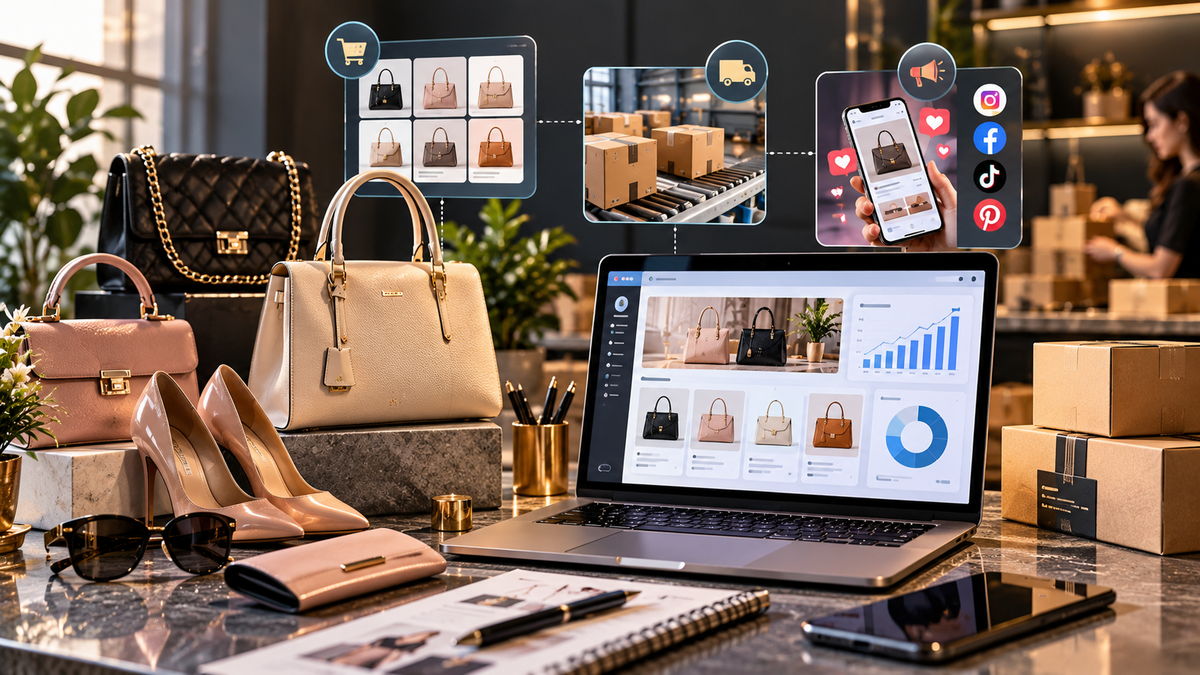
Dropshipping handbags can be an attractive ecommerce niche because the products are highly visual, easy to demonstrate in short-form content, and suitable for focused fashion branding. But the business model is not as simple as uploading a few handbags and waiting for sales. Product quality, supplier reliability, shipping time, returns, pricing and marketing all matter.
This guide explains how a handbag dropshipping business works in 2026, what types of products to test, how to think about margins, what to check in a supplier, and how to market a handbag-and-heels store realistically. It also explains where a ready-made store can save setup time—and what work still remains after handover.
What This Means for You
A handbag dropshipping store lets you sell fashion accessories without buying large amounts of inventory upfront. When a customer orders, the supplier fulfills the order and ships it to the customer. Shopify describes dropshipping as a model where the merchant does not keep the products in stock and the supplier handles fulfillment, which can reduce upfront inventory costs and logistics. However, the merchant is still responsible for the customer experience, pricing, marketing, policies and support.
That makes handbags a good fit for entrepreneurs who prefer branding and marketing over warehouse management. It is a weaker fit if you expect a completely passive business or do not want to deal with customer questions, product-quality issues or returns.
Why Handbags and Heels Work Well as a Focused Niche
Fashion ecommerce remains a very large online category. Shopify's 2026 fashion industry research highlights continued ecommerce growth, strong social-commerce adoption and meaningful online demand across apparel, footwear and accessories. Handbags and luggage also remain a commercially important fashion category.
The bigger advantage is not simply market size. Handbags and heels are visually driven products. Buyers often make decisions based on style, color, outfit matching, perceived quality and occasion. That gives a new store multiple content angles:
- Outfit pairing: show one handbag with casual, work and evening looks.
- Occasion-based merchandising: work bags, date-night bags, travel bags, party heels and everyday accessories.
- Color stories: neutral collections, black-and-gold collections, seasonal colors and capsule wardrobes.
- Short-form video: unboxing, what-fits-inside, styling transitions and close-up material shots.
- Bundles and cross-sells: pair handbags with heels, wallets, sunglasses or other accessories.

What Handbag Products Should You Test?
Do not build the entire store around one untested style. Start with several product groups so you can learn what your audience responds to. Shopify's current dropshipping guidance recommends choosing a niche, researching demand and testing products rather than assuming one item will work immediately.
| Product type | Why it can work | What to check before listing |
|---|---|---|
| Crossbody bags | Everyday use, easy to demonstrate, broad styling appeal | Strap strength, size accuracy, zipper quality |
| Tote bags | Work, shopping and travel use cases | Capacity, handle stitching, interior compartments |
| Evening bags / clutches | Strong occasion-based merchandising | Finish quality, closure, dimensions, color accuracy |
| Structured handbags | Premium visual positioning | Material consistency, hardware quality, packaging |
| Heels | Natural cross-sell with handbags and outfits | Sizing chart, comfort, return risk, packaging protection |
| Small accessories | Useful add-ons for order-value growth | Supplier consistency and whether split shipments will occur |
A focused store does not need hundreds of products on day one. A smaller, well-organized range can make it easier to create stronger product pages, better collections and clearer advertising angles.
How to Calculate Your Margin Before Running Ads
The selling price minus the supplier price is not your true profit. You need to include all variable costs that can affect an order.
A simple calculation is:
Selling price - product cost - shipping - transaction/payment fees - expected refund/return allowance - advertising cost = estimated contribution profit.
For example, if a bag sells for $55 and the product plus shipping costs $22, you do not automatically make $33. Payment processing, advertising, returns and any discounts still need to be covered. If customer acquisition costs $20, the economics are very different from a sale generated organically.
This is why handbag dropshipping should be treated as a testing business. Your goal is to identify combinations of product, price, creative and audience that leave enough margin after real costs. EcomChief has a separate guide on calculating dropshipping profit before running ads if you want a deeper framework.
How to Choose a Handbag Dropshipping Supplier
Supplier quality can make or break a fashion store. Shopify's 2026 dropshipping guidance specifically warns merchants not to judge suppliers or dropshipping apps only by popularity. Shipping speed, product quality, reliability and support matter more than install numbers or marketing claims.
Before adding a handbag or pair of heels, check:
- Product samples: order samples whenever possible before scaling.
- Material and stitching: inspect seams, lining, zippers, clasps and straps.
- Accurate photography: make sure the received product resembles the supplier photos.
- Shipping time: test delivery to the countries you plan to target.
- Tracking: confirm when tracking becomes available and how reliable updates are.
- Packaging: fashion accessories can be damaged or lose perceived value with poor packaging.
- Returns: understand who pays return shipping and how defective products are handled.
- Stock stability: avoid building ad campaigns around products that disappear frequently.
- Communication: test how quickly the supplier responds before there is a customer problem.

Be Careful With Split Shipments and Returns
A fashion store can look simple on the front end while becoming complicated behind the scenes. If a customer buys a handbag, heels and sunglasses from three different suppliers, they may receive three packages on different days. That creates more tracking questions and can make the customer experience feel disorganized.
Shopify's Help Center recommends aligning product selection with supplier capabilities and notes that bundling products from one supplier can simplify fulfillment. For handbag stores, this can mean choosing suppliers that carry complementary accessories rather than sourcing every item from a different catalog.
Returns also deserve special attention. Handbags may be easier than apparel because there is no garment sizing, but heels introduce size and comfort issues. Your product pages should include clear measurements, size information, materials, shipping expectations and return rules.
Should You Sell Only Handbags or Add Heels and Accessories?
A handbag-only store is easier to position because the brand promise is extremely clear. It can also make product sourcing, content creation and customer expectations simpler. The drawback is that you have fewer natural cross-sell opportunities.
Adding heels, wallets, sunglasses or small fashion accessories can raise the number of combinations you can merchandise, but only if the categories feel coherent. A store should still look like one brand serving one type of customer—not a random catalog.
A practical approach is to use handbags as the core category and add a small number of complementary products. For example, a neutral workwear collection might combine structured totes with simple heels, while an evening collection might pair clutches with party shoes. This gives you more content and bundle ideas without losing the niche.
Operationally, keep the supplier issue in mind. If the handbag and heel come from different suppliers, the customer may receive separate parcels. Make that clear before checkout and avoid promising delivery dates you cannot control.
How to Market a Handbag Dropshipping Store in 2026
Fashion is one of the strongest categories for visual marketing. Shopify's 2026 fashion research identifies social commerce and shoppable content as important industry trends. That means your marketing should not rely only on static product photos or paid ads.
A practical content system can include:
- Styling videos: one bag with three outfits.
- What fits inside: demonstrate actual size better than dimensions alone.
- Close-up quality shots: hardware, stitching, texture and compartments.
- Handbag + heel combinations: turn separate products into a complete look.
- Occasion hooks: office, date night, travel, wedding guest or weekend.
- UGC-style content: natural phone-shot videos that feel less like traditional ads.
- Comparison content: small vs. large bags, shoulder vs. crossbody, neutral vs. statement styles.
- Customer FAQs: shipping time, materials, dimensions, returns and care.
The goal is to create enough useful creative variations to discover what customers respond to. Do not assume that one ad or one influencer post will determine whether the niche works.

What Should Your Product Pages Include?
Fashion buyers cannot physically inspect the product, so the page has to reduce uncertainty. Each handbag page should clearly show:
- multiple product angles;
- close-ups of materials and hardware;
- exact dimensions;
- strap length where relevant;
- interior compartments;
- material description;
- realistic shipping estimates;
- returns information; and
- care instructions where appropriate.
Avoid exaggerated luxury claims unless the product and supplier evidence support them. It is better to build trust with accurate details than to make a low-cost item sound like a designer product.
Common Handbag Dropshipping Mistakes to Avoid
The fastest way to waste money in this niche is to spend heavily before you have validated the product, supplier and creative angle. Keep these mistakes in mind:
- Choosing products only because they look expensive. Visual appeal matters, but customers notice weak stitching, inaccurate colors and cheap hardware after delivery.
- Using supplier photos without testing them. Generic catalog images can make your store look identical to competitors. Create original photos or video once a product earns more attention.
- Ignoring landed cost. A low supplier price can become unattractive after shipping, payment fees, refunds and advertising are included.
- Running ads before ordering samples. You do not want the first quality inspection to happen after a customer complains.
- Launching too many products. A smaller collection is easier to test and gives you clearer performance data.
- Hiding long delivery times. Unrealistic promises increase support tickets, chargebacks and negative reviews.
- Depending on one supplier. Shopify recommends preparing alternative supply options because a single supplier can become a bottleneck when stock or fulfillment changes.
- Treating traffic as the same thing as profit. A campaign can generate clicks and even sales while losing money after all costs are counted.
The operating principle is simple: validate first, scale second. That applies whether you build the store yourself or start from a ready-made foundation.
Should You Build the Store Yourself or Buy a Ready-Made Foundation?
There are two legitimate approaches. You can build a Shopify store from scratch, choose a theme, organize collections, write policies, connect suppliers and create the product structure yourself. Or you can start with a ready-made store and spend more of your time on products, creative testing and marketing.
EcomChief's current Ready-Made AI Handbags & Heels Dropshipping Business is an example of the second approach. As verified directly in the live Shopify catalog on September 25, 2026, the active product currently has a $99 USD “Just the store” option and a $148 USD option that includes the store plus the listed traffic/SEO package. Prices and availability can change, so check the live product page before purchase.
The important point is expectation setting. A ready-made store can reduce technical setup time, but it does not guarantee customers, traffic, sales or profit. You still need to validate products, check suppliers, create marketing content, handle customer support and improve the store based on real data.
A Simple 30-Day Handbag Dropshipping Launch Plan
| Week | Main focus | Key actions |
|---|---|---|
| Week 1 | Supplier and product validation | Shortlist products, order samples, verify shipping and returns, remove weak items |
| Week 2 | Store and content preparation | Improve product pages, build collections, create 10-15 short-form content pieces |
| Week 3 | Traffic testing | Launch organic content and small controlled paid tests; track clicks, add-to-carts and sales |
| Week 4 | Optimization | Cut weak products/creatives, improve winning pages, test bundles and follow-up marketing |
Do not judge the entire niche after a few days. Instead, judge individual products and marketing angles. A poor-performing handbag can fail while another style performs well with the same audience.
Final Take: Handbag Dropshipping Is a Marketing Business
Handbag dropshipping can be a practical way to enter fashion ecommerce without purchasing bulk inventory, but the store itself is only the foundation. The real work is product selection, supplier control, pricing, content, customer acquisition and service.
If you want to start faster rather than build every Shopify element from scratch, you can view EcomChief's Ready-Made AI Handbags & Heels Dropshipping Business. Compare the current inclusions, verify the live price, and treat the store as your starting platform—not as a promise of automatic revenue.
Related reading
All articles


Free Online Business Calculators
Estimate costs, profits, ROI, affiliate earnings, and business value before you spend money.