
BuyingGuide
Starting a Shopify Store on a Minimal Budget — What's Actually Realistic in 2026
Is $1,000 enough to start dropshipping" gets searched constantly, and most answers dodge the actual math. Here's the real budget breakdown at $500, $1,000, and $2,000.
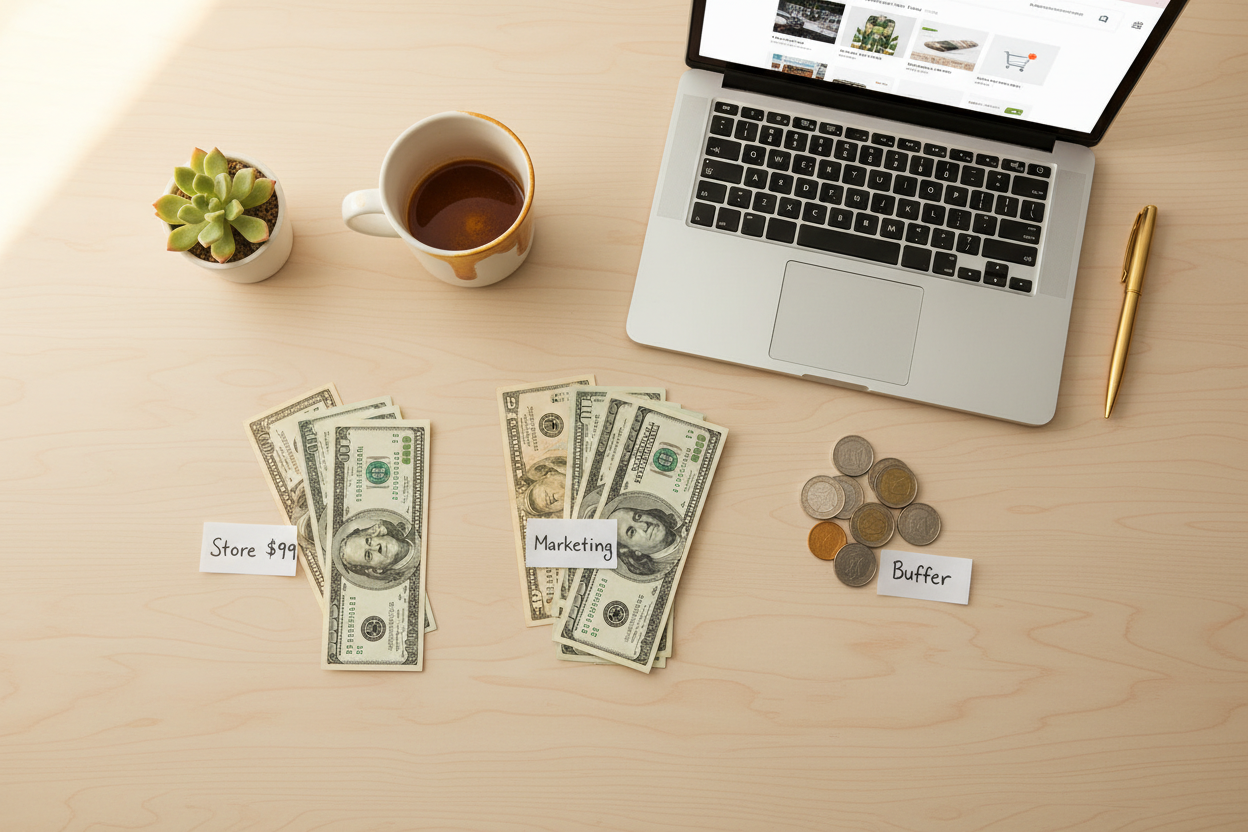
Quick Answer: Yes, $1,000 is enough to start a Shopify store if you allocate it correctly — the mistake most beginners make is spending too much of it on the store itself and too little on the marketing that actually generates traffic. A realistic split at $1,000 looks like roughly $99 for a genuinely done-for-you store, leaving around $900 for ad testing and initial marketing. Spending $500 or more on the store alone before you've proven the niche works is the single most common way beginners run out of budget before they get meaningful traffic data.
Reddit's dropshipping forums are full of the same question — is $1,000 enough? Most answers are vague. I want to give you the actual mechanics: what a $99 store leaves you, what ad platforms actually require as a minimum, and what a realistic three-week test looks like in real numbers.
"Is $1,000 enough to start dropshipping" is one of the most consistently searched questions in this entire space, and I've noticed most answers to it avoid the actual math. They talk generally about "budgeting wisely" without ever showing what wise budgeting looks like in real numbers. I want to do the opposite — walk through exactly how I'd split $500, $1,000, and $2,000 budgets if I were starting from scratch today, why the store itself should be the smallest line item in that budget rather than the largest, and where I see beginners consistently get the allocation backwards.

How Much Money Do I Need to Start a Shopify Store — The Real Line Items
Key Takeaway: A realistic Shopify startup budget has four line items — the store itself, Shopify's monthly subscription, initial ad testing, and a buffer for the unexpected — and beginners consistently overweight the first item and underweight the third, which is backwards for actually generating revenue.
Before splitting a specific dollar figure, it helps to name what you're actually paying for. First, the store itself — design, product catalog, and supplier setup. Second, Shopify's own subscription, typically $29 to $39 a month depending on the plan. Third, and by far the most important line item for actually generating revenue, marketing and ad testing — the money you spend learning which products and audiences convert. Fourth, a small buffer for anything unexpected, because something always comes up in the first month that you didn't budget for.
The mistake I see most often is treating the first line item as the place to invest most heavily, on the logic that a better store must mean better results. It doesn't work that way. A $99 store built to a genuinely custom design standard and a $2,000 custom-built store from an agency can convert similarly if the product-market fit and marketing execution are the same — the store sets a ceiling on conversion rate, but traffic and offer quality determine whether you ever get close to that ceiling. Spending $1,900 more on the store and having $1,900 less to spend learning what actually sells is close to the worst possible allocation for a beginner.
Is $1,000 Enough to Start Dropshipping — The Full Breakdown
Key Takeaway: At $1,000, a $99 done-for-you store leaves approximately $900 for Shopify's subscription, ad testing, and a buffer — enough to run a genuine test of whether a niche and offer convert, which is the actual goal of a first budget, not building the perfect store.
Here's how I'd split $1,000 if I were starting today. $99 for a fully done-for-you Shopify store — meaning custom design, curated products, and verified supplier connections, not a bare theme you still have to finish yourself. Roughly $40 for the first month of Shopify's subscription. That leaves approximately $860 for marketing, which is where the real test happens.
Split that $860 as a testing budget rather than a single campaign — I'd run it across two to three product angles at $15 to $25 a day each for the first two to three weeks, watching for early signal on click-through and add-to-cart rate before committing more heavily to any single winner. That approach gives you real data across multiple angles rather than betting the entire budget on one untested assumption. If you want the marketing side handled for you rather than testing it yourself from scratch, our $148 traffic package add-on is built for exactly this — it gets your first campaigns running without you having to learn ad platform mechanics from zero while also trying to run the store.
| Total Budget | Store | Shopify (1 Month) | Marketing Test Budget |
|---|---|---|---|
| $500 | $99 | $40 | ~$360 |
| $1,000 | $99 | $40 | ~$860 |
| $2,000 | $99 + $148 traffic package | $40 | ~$1,713 |
What's Realistic at $500 — The Tighter Version
Key Takeaway: A $500 budget still works with the same $99 store, but the marketing test window narrows considerably — realistic expectations at this level mean testing one product angle carefully rather than several simultaneously.
At $500, the same $99 store and roughly $40 for Shopify leave about $360 for marketing. That's tighter, but it's still workable if you narrow your approach — test one strong product angle rather than spreading thin across three, running $10 to $15 a day for two to three weeks. The goal at this budget level isn't to run a comprehensive test across multiple angles; it's to get a clear yes-or-no signal on a single, carefully chosen offer before deciding whether to reinvest revenue into scaling it or pivot to a different angle. I covered the broader realism check on tight-budget starts in our post on starting Shopify dropshipping with no money — worth reading if $500 already feels like a stretch, because the honest answer at that level requires even more deliberate sequencing.
What Changes at $2,000 — More Room for Testing, Not a Better Store
Key Takeaway: A larger budget should expand your marketing testing capacity, not push you toward a more expensive store — the extra room at $2,000 is best spent on the $148 traffic package or a longer, more thorough ad testing window, not on upgrading the store itself.
At $2,000, the temptation is to spend more on the store, assuming a bigger budget justifies a fancier product. I'd resist that instinct. The $99 done-for-you store, if it's genuinely custom-designed and properly handed over, gives you the same design ceiling as a much more expensive one — what changes at $2,000 is how much runway you have to test and learn before you need to see results. That extra room is better spent on the $148 traffic package to get professional marketing support running from day one, plus a meaningfully longer testing window across more product angles, giving you real data instead of a longer wait before your first test even begins.

What's the Cheapest Way to Launch an Online Business — Without Cutting the Wrong Corner
Key Takeaway: The cheapest realistic way to launch is minimizing store cost without minimizing store quality — a $99 custom-built store costs the same as a generic templated one, so there's no genuine savings in choosing a worse-designed option to save money.
This is worth stating plainly because it's a common point of confusion: cutting cost on your Shopify launch does not have to mean cutting quality. A $99 store built from a locked custom design system — the method documented across our Shopify section-building series — costs the same as a generic templated store with swapped colors. There's no genuine savings in choosing the worse-designed option; you'd be paying the same price either way. The actual place to be genuinely frugal is in your marketing testing discipline — spending in small, deliberate increments while you learn, rather than committing a large budget to an unproven angle before you have any data.
Can I Start Dropshipping With $1,000 — The Honest Verdict
Key Takeaway: $1,000 is a workable starting budget for Shopify dropshipping when the store cost is kept to its genuine minimum and the majority is reserved for marketing testing — it becomes an unrealistic budget only when a beginner spends most of it on the store and has little left to actually generate traffic.
The honest verdict is yes, with the caveat that the allocation matters more than the total figure. $1,000 spent as $99 on a genuinely done-for-you store and roughly $860 on deliberate marketing testing gives you a real shot at learning whether a niche and offer convert. $1,000 spent as $500 or more on the store and the remainder scattered across marketing without a clear testing plan gives you a much weaker starting position, even though the total budget is identical. The number matters less than the discipline behind how it's split. If you want to start with the store cost genuinely minimized so more of your budget goes toward the marketing that actually drives revenue, browse EcomChief's catalog — every store is $99 flat, with the $148 traffic package available if you'd rather have marketing support handled for you than run the testing yourself.

Keep the Store Cost Low — Put Your Budget Where It Actually Drives Revenue
Key Takeaway: EcomChief's $99 flat price keeps the store line item small on purpose, so more of a limited starting budget goes toward the marketing testing that actually determines whether a business works.
The stores in EcomChief's catalog are built using the exact method described in this post. Not templated. Not assembled from a page builder. Custom sections, locked design systems, production-ready — the same standard I hold my own theme to. Every store starts at $99, with an optional $148 traffic package if you want marketing support from day one. If you want to own a store built this way without spending months developing the method yourself, this is where to start.
The Bottom Line
Key Takeaway: Starting a Shopify store on a minimal budget is realistic when the store is kept to its genuine minimum cost without sacrificing design quality, and the bulk of the budget goes toward deliberate, small-increment marketing testing rather than a single unproven bet.
The honest math on a $500, $1,000, or $2,000 Shopify budget comes down to the same principle at every level: the store should be the smallest line item, not the largest, because it sets a conversion ceiling you'll likely never reach if there's nothing left to spend learning whether your offer and audience actually convert. A $99 done-for-you store keeps that line item genuinely minimal without sacrificing the design quality that gives you a real shot at conversion. Everything else in the budget should go toward disciplined, incremental marketing testing — the part of this process that actually determines whether the business works. If you're planning your first budget right now, start with the store cost fixed and low, then build your marketing test plan around whatever's left. Browse EcomChief's catalog to see what a genuinely $99 done-for-you foundation looks like before you commit the rest of your budget elsewhere.
Helpful EcomChief Resources
Key Takeaway: These links give you direct access to EcomChief's catalog, free budgeting tools, and the broader content series on starting a Shopify business realistically at any budget level.
Here are useful links to continue your research:
- Browse All Ready-Made Businesses — From $99
- Ready-Made Dropshipping & Ecommerce Stores
- Ready-Made Digital Agency Businesses
- Ready-Made Affiliate Sites
- What's Included in Every Sale
- Free EcomChief Tools & Calculators
- The Handover Process — Step by Step
- Talk to EcomChief Before You Buy
- How to Start Shopify Dropshipping With No Money
- Shopify Stores for Sale — Where to Find Them
- What Is a "Done for You" Shopify Store — And Is It Worth Paying For?
- Which Shopify Store Niches Make the Most Money?
If you're planning your first budget right now, use the free startup cost calculator to model your own numbers, then browse the catalog to see the $99 foundation this post is built around.
Related reading
All articles
Free Online Business Calculators
Estimate costs, profits, ROI, affiliate earnings, and business value before you spend money.