
ShopifyStores
How to Find Profitable Product Ideas for an Online Store
Learn how to find and validate product ideas for an online store using demand, margins, competition, supplier checks, and low-risk tests. Includes EcomChief’s practical product-idea scorecard.

Product ideas are only useful when you can validate the demand, economics, competition and fulfilment behind them. Start by identifying a real customer problem or buying occasion, then compare search interest, competitor activity, supplier quality, pricing room and low-risk test results. The goal is not to predict a guaranteed “winner.” It is to eliminate weak ideas early and give the strongest ideas a disciplined first test.
What This Means for You
If you are deciding what to sell online, do not build a full store around the first product that looks popular on social media. A trend can attract attention without producing a workable business. A better process is to collect several product ideas, score them using the same criteria, and test the top candidates before you commit significant money to inventory, advertising or custom development.
This is especially important for a beginner. You usually have limited capital and limited data, so your advantage is not perfect forecasting. It is making small, reversible decisions. EcomChief's existing guide to choosing the right online-business niche looks at market-level fit. This guide goes one level deeper: how to choose and validate the actual products or product directions inside that market.
Start With a Customer Problem, Use Case or Buying Occasion
A useful product idea normally starts with a reason to buy. That reason may be a recurring problem, a convenience improvement, a hobby, a gift occasion, a replacement need, a status or style preference, or a product people already buy but dislike in its current form.
Instead of asking only, “What is trending?”, ask more specific questions. What task is frustrating? What product is frequently replaced? What do buyers complain about in reviews? What do people buy together? What questions appear repeatedly before purchase? What would make the product easier to demonstrate, compare or trust?
This changes product research from random browsing into customer research. For example, “pet products” is too broad to evaluate. “A compact travel-water system for dog owners who take weekend road trips” gives you a customer, a use case, competing alternatives and a clear set of buying questions to investigate.

Where to Find Better Product Ideas
You do not need one secret database. Strong ideas usually appear when several independent signals point in the same direction. Use multiple sources and look for repetition.
- Customer reviews: Read both positive and negative reviews for existing products. Repeated complaints can reveal missing features, poor sizing, durability issues, confusing instructions or packaging problems.
- Search behavior: Look for the language people use around a problem, product category and comparison. Search interest does not prove purchase intent, but it can show whether a topic has persistent or rising attention.
- Competitor stores and marketplaces: Note which products receive prominent placement, how offers are bundled, which customer questions are answered, and where competitors look interchangeable.
- Social and creator content: Use short-form video, YouTube, forums and communities to see what people demonstrate, compare, complain about or repeatedly ask for. Treat engagement as a signal to investigate, not proof of profitability.
- Supplier catalogs and trade sources: Suppliers can reveal variations, minimums, lead times, packaging options and product families. Never treat supplier popularity claims as independent demand evidence.
- Adjacent niches: A product that solves a proven problem in one market may inspire a useful variation for another market, provided the customer need genuinely transfers.
Shopify's current guide to finding product ideas similarly recommends actively searching for opportunities rather than waiting for a single inspiration moment. Its 2026 product research also points to categories such as shirts, skin care, makeup, activewear and motor-vehicle parts as high-demand areas among Shopify merchants. Those category signals can help you brainstorm, but they are not a guarantee that a particular item, offer or store will work.
Validate Demand Without Confusing Interest With Sales
Demand validation should combine several types of evidence. No single metric tells you whether a product will sell profitably for your store.
Start with search evidence. Google Trends is useful for comparing relative interest over time and by region, but its numbers are not absolute search volumes. Google explains that Trends uses a sample of searches, normalizes results to the selected time and geography, and scales relative interest from 0 to 100. Google also warns that Trends should be treated as one data point rather than a complete measure of popularity. That makes it useful for direction, seasonality and comparisons—not as a sales forecast. See Google's official explanation of Trends data.
Then add commercial evidence. Are multiple credible sellers carrying the product? Are customers leaving recent reviews? Are there repeated buyer questions? Are related accessories or refills being sold? Can you find evidence that people are actively comparing options rather than merely watching entertaining videos?
Finally, use a small real-world test where practical. A landing page, waitlist, preorder where legally and operationally appropriate, small product batch, organic content test or tightly capped advertising test can produce stronger evidence than another week of browsing. Shopify's current product-market fit guidance recommends validating demand before committing heavily and measuring real signals such as purchases, repeat behavior, reviews and referrals as the product matures.
Check the Unit Economics Before You Fall in Love With the Product
A product can have demand and still be a poor business choice. Before you invest, build a simple per-order model.
Estimate the selling price, product cost, inbound or supplier shipping, payment fees, fulfilment costs, expected return or replacement burden, marketplace or app fees where relevant, and a realistic allowance for customer acquisition. Do not use markup alone. A product bought for $10 and sold for $30 has a 200% markup on cost, but that does not mean you keep $20 after every other expense.
Use EcomChief's dropshipping profit calculator if you are testing a dropshipping product, or the online business startup cost calculator when you need a broader view of launch expenses. These tools provide planning estimates based on your inputs; they are not forecasts or guarantees.
Mid-article next step: If your product economics look workable but you do not want to build the storefront from zero, you can compare EcomChief's ready-made ecommerce and dropshipping store foundations. Treat the store as a starting asset; you still need to validate the products, audience and acquisition plan yourself.

Test Competition and Differentiation Together
Competition is not automatically bad. A market with no visible competitors may have no demand. The practical question is whether you can explain why a particular buyer should choose your offer.
Review the first page of search results, marketplace listings, social content and major stores in the category. Record common price points, delivery expectations, product specifications, guarantees, bundles, review themes and positioning. Then look for a defensible difference.
Your difference does not need to be a patented invention. It may be a better bundle, clearer product education, faster local delivery, improved sizing guidance, a more specific audience, better compatibility information, a gift-ready offer, stronger photography, more useful content or a store built around a coherent use case rather than a random catalog.
A warning sign is when your entire plan is “sell the same item for less.” Price competition can erase the margin you need for customer acquisition, returns and support. If you cannot describe a reason to choose your offer without mentioning price, keep researching.
Where to Buy Products to Sell Online
Once an idea survives the first demand and economics checks, sourcing becomes part of validation. The best source depends on whether you want dropshipping, wholesale inventory, private label, local manufacturing, handmade goods or digital products.
Possible sources include manufacturers, authorized distributors, wholesalers, dropshipping suppliers, trade shows, industry directories, local makers and supplier platforms. Compare at least two viable sources when possible so you are not designing the whole business around one catalog entry.
Before choosing a supplier, verify the actual product specification, unit cost, minimum order quantity if any, processing time, shipping regions, tracking, packaging, return process, replacement policy, stock reliability and whether branding or private-label options create extra lead time. Order a sample when product quality, fit, material or packaging matters.
Also check whether the product category creates additional compliance obligations. Cosmetics, supplements, children's products, medical-related goods, electronics, batteries and products making health or performance claims can require more careful supplier documentation and market-specific review. A supplier listing is not evidence that a product is compliant everywhere you intend to sell it.
The EcomChief Product-Idea Validation Scorecard
Use this scorecard to compare ideas consistently. It is a prioritization tool, not a prediction model. Score each factor from 1 to 5 and write one sentence of evidence beside the score. Do not award points based on optimism.
| Factor | What you are checking | What stronger evidence looks like |
|---|---|---|
| Demand evidence | Is there credible evidence that people want the outcome or category? | Several independent signals: search interest, active sellers, recent reviews, buyer questions and test response. |
| Customer clarity | Can you identify who buys and why? | A specific customer, use case and purchase trigger. |
| Problem or desire strength | Does the product solve something meaningful enough to pay for? | Repeated complaints, recurring need, clear convenience, hobby or gifting motivation. |
| Differentiation | Can the offer be distinguished without relying only on lower price? | Useful bundle, positioning, content, service, product variation or delivery advantage. |
| Economics room | Is there enough contribution margin after variable costs? | Conservative estimates still leave room for returns, support and acquisition. |
| Fulfilment risk | Can the product be sourced and delivered reliably? | Multiple suppliers, stable stock, workable shipping, low damage risk and clear returns. |
| Content and demo potential | Can you show, explain or teach the product repeatedly? | Many useful demonstrations, comparisons, tutorials, use cases and creator angles. |
| Expansion potential | Can one sale lead to related products or a broader catalog? | Accessories, replacements, bundles, repeat purchases or adjacent products. |
A maximum score is 40. As a working rule, ideas scoring in the low 30s or higher may deserve a controlled test, ideas in the mid-20s usually need more evidence, and lower-scoring ideas should normally be reworked or rejected before you spend heavily. The number is not a probability of success. Its purpose is to make weak assumptions visible.

Use a Low-Risk Product Validation Sequence
- Build a shortlist of five ideas. Avoid committing to one product before comparison.
- Define the customer and use case. Write one sentence explaining who buys, what triggers the purchase and what alternative they use today.
- Check demand signals. Compare search interest, reviews, competitor activity, buyer questions and seasonality. Use Google Trends carefully as relative evidence, not a volume forecast.
- Pressure-test the numbers. Estimate contribution margin after product cost, shipping, payment fees, returns and acquisition assumptions.
- Verify sourcing. Compare suppliers, order samples when practical and confirm delivery, stock and return conditions.
- Create the smallest credible test. Use a landing page, content test, waitlist, preorder, sample batch or capped ad experiment appropriate to your product and market.
- Decide using evidence. Continue, modify or reject the idea based on what the test taught you. Do not keep spending merely because you have already invested time.
If you are unsure who the test should target, use EcomChief's guide to finding your target market for an online business before you launch traffic. Product validation and audience validation should reinforce each other.
Should You Build a Store From Scratch or Start With a Ready-Made Foundation?
These are separate decisions. Product validation answers “what should I test?” Store setup answers “what infrastructure do I need to test and sell it?”
Building from scratch gives you maximum control over structure and branding, but it also creates more setup work before you learn whether the offer is attractive. A ready-made ecommerce foundation can reduce design and configuration time, especially when you already know the niche you want to explore. It does not turn an unvalidated product into a proven one.
That distinction matters. EcomChief primarily sells starter assets and ready-made business foundations, not established businesses with guaranteed historical revenue. The value is a faster technical starting point. The new owner remains responsible for product decisions, marketing, customer acquisition, supplier checks and ongoing operations.
Final Decision: Pick the Idea With the Best Evidence, Not the Most Hype
The best product ideas for an online store are not necessarily the newest, most viral or highest-priced. They are the ideas for which you can build the strongest evidence chain: a clear customer, a real use case, visible demand, workable economics, reliable sourcing, a credible reason to choose your offer and a low-risk way to test it.
Shortlist several ideas, use the same scorecard for each one, test the strongest candidate conservatively, and be willing to reject it when the evidence is weak. That discipline is more valuable than trying to predict a guaranteed winner.
If you want to move from product research into execution, browse EcomChief's ready-made ecommerce and dropshipping store foundations, then apply the validation framework in this guide before committing serious marketing spend.
Related reading
All articles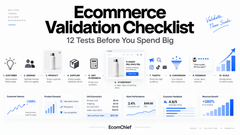


Free Online Business Calculators
Estimate costs, profits, ROI, affiliate earnings, and business value before you spend money.