
BuyingGuide
Online Businesses for Sale Under $5,000: What You Can Actually Buy
What can a $5,000 online-business budget realistically buy? Compare starter assets with established businesses, see current EcomChief examples, and use a practical due-diligence and budget framework before you pay.

If you are looking for online businesses for sale under $5,000, the most important question is not “How cheap can I buy?” but “What am I actually buying?” At this budget, you can find starter websites, ecommerce stores, affiliate sites, agency foundations, apps and occasionally small operating digital businesses. The assets, evidence, transfer process and post-purchase work can be completely different.
What This Means for You
A sub-$5,000 budget can be enough to get a genuine online-business foundation, but it does not automatically buy proven revenue, customers or passive income. The safest approach is to separate starter assets from established operating businesses, then judge each deal using the right evidence.
That distinction matters at EcomChief in particular. EcomChief primarily sells ready-made starter assets: professionally prepared business foundations designed to reduce setup time. They are not represented as established companies with verified historical sales, traffic or profit unless a specific listing explicitly proves and transfers those things.
What Can You Realistically Buy for Under $5,000?
There are several very different purchase types inside the same “business for sale” search. A buyer who understands the difference is much less likely to overpay.
| What you are buying | What may be included | What you should not assume | Best fit |
|---|---|---|---|
| Starter ecommerce asset | Store design, product setup, domain or transfer support, basic configuration | Existing customers, proven sales, transferable traffic | Buyer who wants to skip technical setup and focus on launch/marketing |
| Affiliate website foundation | Website, niche structure, content framework, affiliate-ready setup | Approved third-party accounts, rankings, commissions or traffic unless verified | Content/SEO-focused buyer |
| Digital agency foundation | Service website, offers, positioning, lead-capture structure | Existing client book, recurring retainers or staff | Service seller who wants a faster market-ready presence |
| App / SaaS starter asset | Application, source code or configured software asset, depending on the listing | Users, MRR, proprietary integrations or production reliability unless documented | Buyer comfortable validating technology and go-to-market work |
| Small operating online business | Potentially revenue, traffic, customers, brand assets and processes | That seller claims are accurate or transferable | Buyer prepared for deeper financial, traffic, legal and technical due diligence |
The same $2,000 or $5,000 asking price can therefore describe completely different deals. A polished starter store with no historical revenue should not be valued or described the same way as an operating site with verifiable earnings.

Starter Asset vs. Established Business: The $5,000 Distinction
This is the most important rule in the entire guide. When an established business is sold, the buyer is usually paying for some combination of historical earnings, customer relationships, traffic, brand equity, systems and transferable operations. Shopify’s current business-acquisition guide describes buying a business as acquiring a company that is already operating and emphasizes valuation and due diligence.
A starter asset is different. You may be buying a well-prepared site, software asset, niche, brand foundation or operating framework that helps you launch faster. The value is in the setup work and the starting point, not in a promise of future income.
That is why a low purchase price is not automatically suspicious, and a higher price is not automatically safer. The right question is whether the price matches the type of asset and the evidence supplied.
What EcomChief Currently Offers Below $5,000
As checked directly in EcomChief’s live Shopify catalog on September 25, 2026, multiple active starter assets are listed far below the $5,000 ceiling. Examples include active ready-made dropshipping, affiliate, agency and app starter assets at $99 USD, while current bundles such as the SaaS App Starter Pack and Ultimate Business Starter Bundle are listed at $245 and $295 USD respectively. Prices and availability can change, so always confirm the live listing before buying.
These prices illustrate why “online businesses under $5,000” is too broad to evaluate by price alone. In EcomChief’s model, a lower purchase price generally reflects a starter foundation rather than an established business with a verified revenue history.
| Budget use | Practical approach | Main risk to manage |
|---|---|---|
| Under $500 | Acquire a starter asset and preserve most of your capital for launch, tools and customer acquisition | Assuming the website itself will create demand |
| $500–$2,000 | Combine a starter asset with branding, content, testing and a measured marketing runway | Overspending on design before validating demand |
| $2,000–$5,000 | Consider a more customized build, larger operating runway, or selectively investigate micro-acquisitions with evidence | Paying an “established business” premium without verified financial and traffic data |
If your goal is to start with a prepared foundation, you can browse EcomChief’s current ready-made ecommerce business assets and compare the live inclusions and price before deciding how much of your total budget should remain for launch.
Do Not Spend the Full $5,000 on the Purchase Price
A common beginner mistake is treating the acquisition budget as the entire business budget. The purchase is only one line item. Even a ready-made asset may still require platform fees, a domain or renewal costs, apps or software, content, testing, creative work, advertising, bookkeeping, professional advice or working capital depending on the model.
A simple way to protect yourself is to split your available cash into three buckets:
- Acquisition: what you pay for the asset itself.
- Launch runway: the cash reserved for the first 60–90 days of operations, testing and customer acquisition.
- Contingency: money you do not plan to spend unless something needs fixing, replacing or reworking.
The percentages will vary by model. A service agency may need little software spend but more outreach effort. A dropshipping store may need product testing and advertising. An affiliate site may need months of content and SEO work before meaningful traffic develops. For a deeper planning method, see EcomChief’s guide to working capital after buying a ready-made online business.

The EcomChief $5,000 Buyer Allocation Framework
Instead of asking “What is the most expensive business I can afford?”, use a reverse budget. Start with how much money must remain after the purchase.
Here is a practical example, not a performance guarantee:
| Example allocation | Amount | Purpose |
|---|---|---|
| Starter asset / acquisition | $500 | Website, store, app or agency foundation |
| Launch and validation runway | $2,000 | Content, creatives, product tests, software, outreach or measured advertising |
| Operations reserve | $1,500 | Platform fees, supplier/customer issues, contractors, technical fixes |
| Contingency | $1,000 | Unplanned costs or additional runway |
The exact numbers should change with the business model. The point is structural: a $5,000 budget gives you more flexibility when you do not lock all $5,000 into the acquisition itself.
If It Claims Revenue, Treat It Like an Acquisition
The moment a seller says a business has established revenue, profit, traffic, customers or recurring subscriptions, the standard of proof should rise sharply. You are no longer judging a starter website by its setup quality. You are evaluating an operating business.
Flippa’s updated buyer due-diligence checklist recommends verifying claims such as revenue, traffic, ownership and transferability rather than accepting a listing at face value. Its 2026 digital-business guidance also emphasizes the durability of customer-acquisition channels, not simply whether the underlying website or app can be reproduced.
Before paying for claimed performance, request evidence that matches the claim:
- Revenue: platform reports plus supporting payout or bank evidence where appropriate.
- Profit: revenue reconciled against real operating expenses, not revenue presented as earnings.
- Traffic: direct analytics access or trustworthy exports showing sources, countries, landing pages and trend history.
- Customers: evidence of customer volume, repeat behavior and whether data can legally and practically transfer.
- Subscriptions: churn, active subscribers, billing platform records and the exact account-transfer process.
- Assets: domains, code, content, trademarks, supplier relationships, ad accounts and licences documented individually.
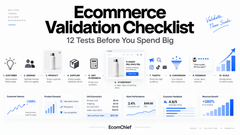
EcomChief’s own 15-check ready-made online business due-diligence checklist provides a structured Pass / Needs Proof / Fail framework you can use before paying.
Red Flags That Matter More Than the Asking Price
A cheap listing can be good value. It can also hide expensive problems. Focus less on the headline price and more on the gap between the seller’s claims and the evidence.
- “Passive income” with no clear operating process. Every model still needs some combination of marketing, maintenance, content, customer support or oversight.
- Revenue screenshots without source access. Screenshots are easy to misunderstand and should not replace verification.
- Traffic that depends on one fragile source. A sudden algorithm, ad-account or platform change can materially affect the business.
- Assets that cannot transfer. A valuable-looking third-party account may be non-transferable under platform rules.
- Unclear ownership of code or content. Confirm licences, contractor agreements and intellectual-property rights.
- A seller pricing a starter site as if it had historical earnings. Setup value and cash-flow value are different.

How to Compare Three Deals Under $5,000
Use the same scorecard for every listing. This prevents a visually impressive site from beating a less glamorous but better-documented opportunity.
| Factor | Deal A: starter asset | Deal B: claimed operating business | Deal C: software/app asset |
|---|---|---|---|
| What transfers? | Website, domain/setup items | Must document site, brand, customer/traffic/financial assets | Code, deployment, licences, documentation |
| Revenue proof required? | No, if no revenue is claimed | Yes | Yes if revenue/MRR is claimed |
| Traffic proof required? | No, if no traffic is claimed | Yes | Yes if users/traffic are part of valuation |
| Main value | Setup time saved | Verified cash flow + transferable operation | Functional technology + rights + deployment quality |
| Main post-purchase job | Launch and acquire customers | Preserve and improve existing operation | Maintain product and acquire users |
Then score each deal from 0 to 2 on five questions: asset clarity, evidence quality, transferability, operating fit and remaining capital. A maximum score is 10. Do not use the score as a substitute for professional due diligence; use it to decide which opportunities deserve deeper investigation.
- 0 = unclear or unsupported.
- 1 = partly documented or needs verification.
- 2 = clearly documented and independently checkable where appropriate.
A $300 starter asset can score well if it accurately describes what is included and what is not. A $4,500 “profitable business” can score poorly if its revenue, traffic or ownership claims cannot be verified.
Which Type of Sub-$5,000 Online Business Fits You?
Your skills matter as much as the price.
- Choose a ready-made ecommerce starter asset if you want to focus on product testing, merchandising and customer acquisition rather than initial store setup.
- Choose an affiliate website foundation if you prefer content, SEO, reviews and long-term audience building.
- Choose a digital agency foundation if you can sell services, prospect for clients and manage delivery.
- Choose an app or SaaS starter asset if you can validate the product, manage technical maintenance and build a user-acquisition plan.
- Choose an established micro-business only when the evidence justifies the premium and you understand how its existing customers and traffic are generated.
If you are still comparing models, EcomChief’s ready-made online business FAQ explains what buyers receive and what responsibilities remain after handover.
Final Decision: Buy the Evidence, Not the Price Tag
Online businesses for sale under $5,000 can be legitimate and useful, but the category contains everything from starter websites to small operating businesses. The smartest buyer does not judge all of them by the same standard.
If you are buying a starter asset, assess the quality of the foundation, the transfer process, what is included and how much launch work remains. If you are buying claimed revenue or traffic, verify the numbers, the customer-acquisition engine, ownership and transferability before you value the business.
For buyers who want a lower-cost starting foundation rather than an established revenue-producing company, view EcomChief’s current ready-made ecommerce business assets, compare the live inclusions, and keep enough of your budget available for the work that begins after handover.
Related reading
All articles

Free Online Business Calculators
Estimate costs, profits, ROI, affiliate earnings, and business value before you spend money.