BusinessIdeas
Ecommerce Validation Checklist: 12 Tests Before You Spend Big
A practical 12-step ecommerce validation checklist to test demand, products, suppliers, unit economics, traffic and customer behaviour before investing heavily.
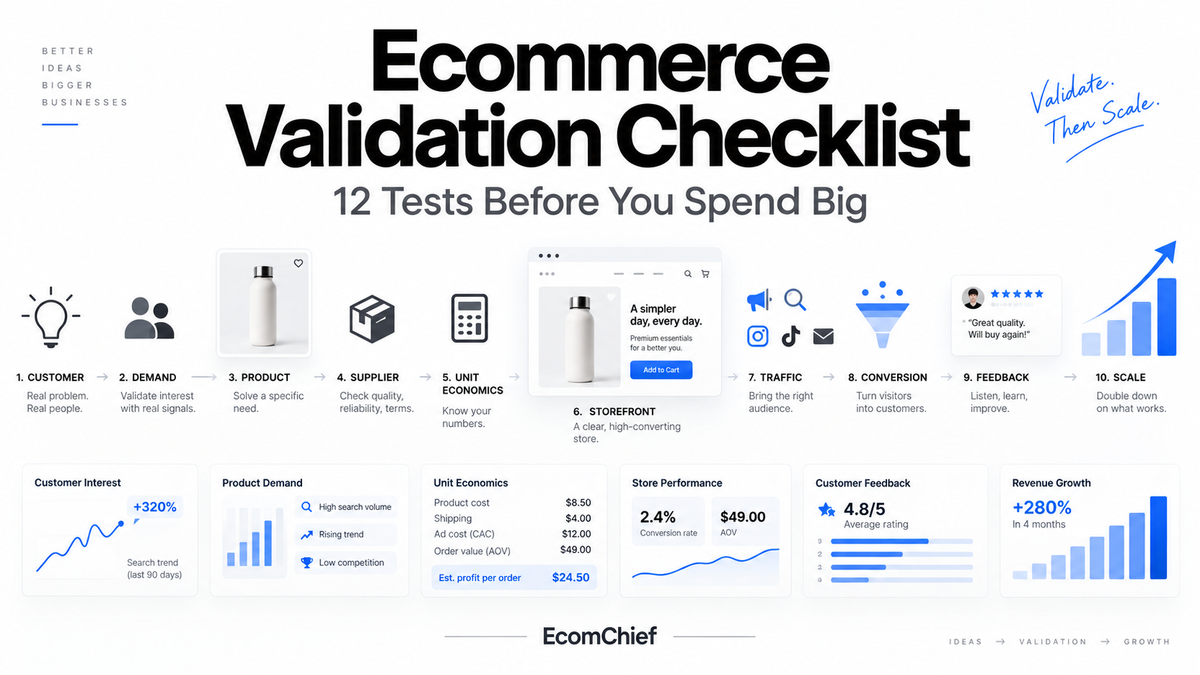
Quick answer: You do not need a fully built ecommerce operation to learn whether an idea deserves more investment. The smarter approach is to test the smallest version that can produce real customer signals, then expand only when the evidence supports it.
I recently wrote about this validation-first approach for Specialty Retailer. This guide expands that idea into a practical ecommerce validation checklist you can use before spending heavily on design, inventory, apps, advertising or a large product catalogue.
Why ecommerce validation matters
A polished store can still fail if the offer is weak. A large catalogue can still fail if customers do not understand why they should buy. Expensive branding can still fail if the acquisition cost is higher than the gross profit.
Validation is therefore not about proving that your idea is guaranteed to work. No test can do that. It is about reducing uncertainty before you commit more money and time.
1. Define one customer and one problem
Start by describing the customer in plain English. Avoid broad labels such as “everyone who shops online.” A usable customer definition is closer to: busy dog owners looking for practical travel accessories, beginner home-gym buyers who want compact equipment, or small retailers testing an online sales channel.
Then define the problem or desire your offer addresses. If you cannot explain the customer and the reason they might buy in one or two sentences, the idea is still too vague.
2. Check whether demand already exists
Look for evidence that people are already searching, discussing, comparing or buying products in the category. Useful signals include search demand, marketplace listings, active advertisers, social content, reviews, community discussions and competitor stores that have been operating for more than a short launch period.
Competition is not automatically a negative signal. In many categories it confirms that demand exists. The more important question is whether you can create a clear angle, audience, offer or merchandising approach that gives customers a reason to choose you.
For a deeper niche check, see our guide on how to validate ongoing product demand.
3. Start with a focused product set
Do not assume you need hundreds of products on day one. A smaller initial catalogue is easier to understand, easier to merchandise and easier to analyse.
A focused test might use 10 to 30 products that represent the strongest use cases or customer needs in the niche. The purpose is to learn which products attract attention, which pages convert and which price points customers respond to.

4. Confirm the supplier and fulfilment reality
A product can look attractive on paper but become a poor business once shipping time, supplier reliability, returns, packaging and customer support are considered.
Before scaling, verify the supplier's current product availability, delivery expectations, tracking capability, refund process and replacement procedure. If possible, order a sample. The goal is to understand the customer experience before you spend heavily driving traffic to the offer.
5. Calculate your real unit economics
Revenue is not profit. Before you run paid traffic, calculate the amount left after product cost, shipping, transaction fees, refunds, platform costs and an estimated customer acquisition cost.
A simple test formula is:
Selling price − product cost − shipping − payment fees − expected refund allowance − acquisition cost = contribution margin.
If the economics only work when advertising is unrealistically cheap, the model needs adjustment. You can also use our online business startup cost calculator to estimate setup costs before committing to a larger build.

6. Build the minimum credible storefront
“Minimum” should not mean careless. The store should still be trustworthy, mobile-friendly and easy to navigate. But you do not need every feature, integration or automation before the first real test.
At minimum, make sure you have clear product pages, shipping information, returns information, contact details, payment methods, a professional domain, basic analytics and a simple path from landing page to checkout.
If you are comparing build costs, our article on the hidden costs of building a Shopify store from scratch explains where budgets often expand.
7. Test the offer before redesigning the brand
Many founders respond to weak sales by changing logos, colours or themes. Sometimes the real problem is the offer.
Test variables such as price, bundle structure, shipping threshold, product positioning, guarantee wording, product selection and the main benefit highlighted above the fold. These changes are closer to the buying decision than cosmetic redesigns.
8. Drive a controlled amount of relevant traffic
Validation requires real visitors. That traffic can come from search, social content, paid ads, communities, influencer outreach or an existing audience. The channel matters less than the relevance of the visitor.
Do not judge an ecommerce idea based on a handful of random clicks. Create a controlled test where the audience, message and landing page are consistent enough that you can learn from the results.
9. Measure behaviour, not just sales
Sales are the clearest signal, but they are not the only useful one. Watch how visitors behave throughout the funnel.
- Which products receive the most views?
- Which pages hold attention?
- What percentage of visitors add to cart?
- Where do people abandon checkout?
- Which traffic sources produce engaged sessions?
- What questions appear repeatedly in customer messages?
These signals can reveal whether the issue is demand, price, trust, checkout friction or traffic quality.

10. Speak to real potential customers
Analytics show what people did. Conversations often explain why.
Ask potential buyers what they currently use, what frustrates them, what would make them switch, what information they need before purchasing and what would make the offer feel risky. Avoid leading questions designed to make people praise the idea.
A person saying “that sounds cool” is weaker evidence than a person joining a waitlist, requesting a quote, adding a product to cart or making a purchase.
11. Set a validation threshold before the test
Decide what evidence would justify further investment before you see the results. That prevents emotion from changing the rules after the test.
Your threshold could be a target number of qualified leads, a minimum add-to-cart rate, a manageable acquisition cost, a certain number of sales, or repeated customer interest in a specific category.
The correct threshold varies by niche and margin. The important point is to define it in advance.
12. Expand only what the data supports
If a focused product group performs better than the rest, expand around it. If one channel brings stronger customers, invest more there. If customers repeatedly ask for a specific variation, consider adding it.
Validation should change what you build next. Otherwise you are collecting data without using it.
A simple 30-day ecommerce validation plan
Week 1: define the customer, shortlist products, check competitors, confirm suppliers and calculate unit economics.
Week 2: prepare the minimum credible storefront, core policies, analytics and a focused offer.
Week 3: drive relevant traffic using one or two channels and record the same core metrics every day.
Week 4: review sales, add-to-cart behaviour, acquisition cost, questions, objections and product-level performance. Decide what to expand, change or stop.

What if you want to start faster?
Some entrepreneurs prefer to buy a ready-made foundation rather than build the entire technical setup from zero. That can reduce setup time, but it does not remove the need for validation, marketing or ongoing improvement.
EcomChief provides ready-made online businesses for buyers who want to begin with an existing structure. The same principle still applies: start with a clear audience, test the offer, measure real behaviour and improve based on evidence.
Frequently asked questions
How much should I spend validating an ecommerce idea?
There is no universal amount. Set a budget small enough that failure is affordable but large enough to generate meaningful customer behaviour. Your product price, traffic source and margin determine what is reasonable.
Do I need a full Shopify store to validate demand?
Not always. Some ideas can be tested with a focused landing page, pre-launch list or small catalogue. If you accept orders, the customer experience still needs to be clear, secure and credible.
How many products should I launch with?
There is no fixed number, but a focused set is often easier to test than a huge catalogue. Choose enough products to represent the niche without making the first test unnecessarily complex.
Does competition mean the niche is saturated?
No. Competition can be evidence of demand. Evaluate whether you have a useful angle, audience, offer, merchandising strategy or customer experience rather than relying on the word “saturated.”
What is the biggest mistake in ecommerce validation?
Spending heavily before obtaining real customer signals. Validation works best when investment increases in stages as evidence improves.
About the author: Ani Nandi is the founder of EcomChief and writes about ecommerce, Shopify, online business setup and practical AI automation. View EcomChief media and publications.
Related reading
All articles


Free Online Business Calculators
Estimate costs, profits, ROI, affiliate earnings, and business value before you spend money.