
BuyingGuide
MacBook Pro 2026: Is Laptop Accessories Dropshipping a Good Business for 2027?
A practical business-buyer guide to evaluating laptop accessories dropshipping after Apple's 2026 MacBook Pro announcement: product compatibility, unit economics, suppliers and a 30-day validation test.
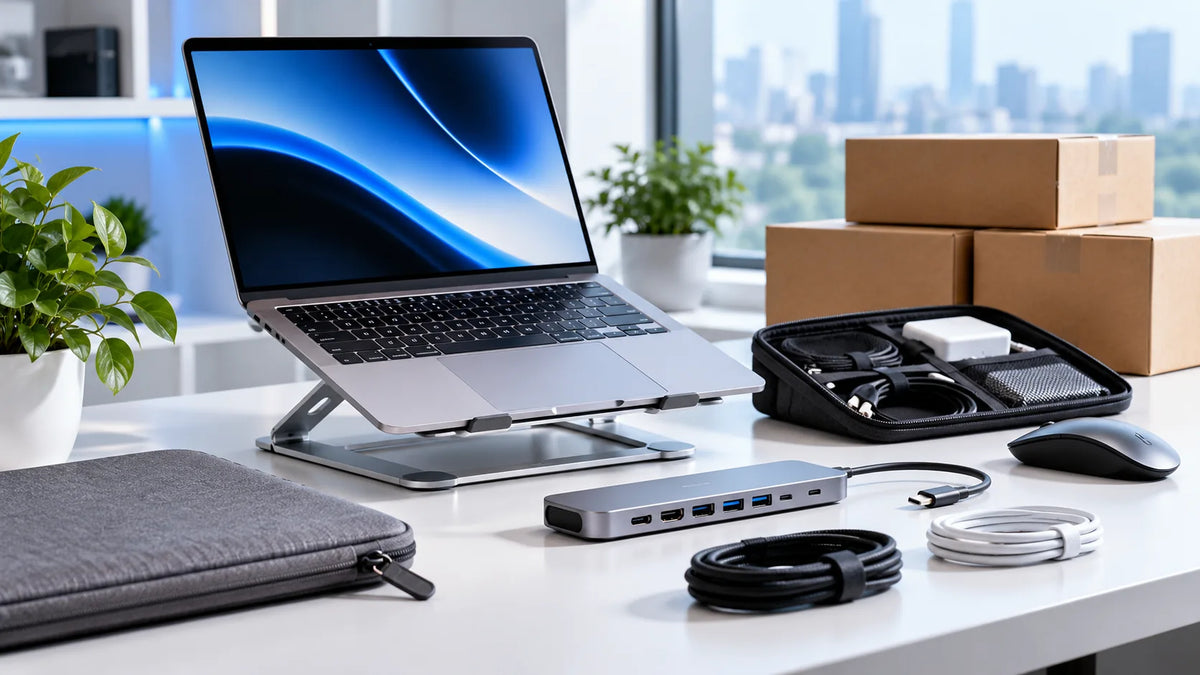
Apple’s October 28, 2026 announcement of its new touchscreen MacBook Pro with a PROLED XDR display has put premium laptops back in the spotlight. Preorders opened that day, with availability announced for November 6. A U.S. Google Trends export for October 25–31 placed “macbook pro” in a 100K+ search-volume bucket. That describes broad consumer and news interest—not orders for laptop accessories, and certainly not demand for ready-made businesses.
For aspiring store owners, the useful question is narrower: Can laptop accessories dropshipping solve specific buyer problems with reliable products, affordable customer acquisition, and margins that survive returns? A product launch can supply research questions, but it cannot validate a business. This guide lays out seven categories to investigate, a compatibility checklist, realistic hypothetical economics, and a 30-day test to run before you spend heavily.
What changed with the 2026 MacBook Pro—and why accessory sellers should care
According to Apple’s October 28 announcement, its new MacBook Pro features a touch-enabled tandem OLED PROLED XDR display, comes in 14-inch and 16-inch configurations, and uses M5 Pro and M5 Max chips. Apple highlights Thunderbolt 5 connectivity and says the new models become available November 6, 2026.
These details matter to accessory merchants not because they guarantee purchases, but because buyers may revisit their workstation setup when they upgrade. A designer might need an external display connection. A consultant may want travel protection. A student might improve desk ergonomics. A remote worker may look for a compact travel organizer. Each represents a problem to investigate, not a confirmed market opportunity.
Do not confuse the presence of a USB-C-shaped connector with guaranteed compatibility. Different computer generations, configurations, hubs, cables, docks, chargers, screens, and power requirements may interact differently. Physical fit matters too: sleeves and stands must accommodate actual dimensions. Refer to the exact machine and accessory manufacturer’s current documentation, and obtain supplier evidence before writing model-specific claims.
Seven laptop accessory categories worth investigating
Think of the following as a shortlist for supplier sampling and market testing, not seven guaranteed winners. The operational ratings are qualitative judgments based on typical size, product complexity and likely support burden; they are not measured industry averages.
| Category | Buyer problem | Proof required before listing | Logistics complexity | Returns/support exposure |
|---|---|---|---|---|
| Adjustable laptop stands | Uncomfortable viewing angle or crowded desk | Load rating, device size, stability, folding dimensions | Low–medium | Medium: wobble, scratches, fit |
| Docks and USB-C hubs | Connecting displays and peripherals | Exact host model, ports, supported data/video modes, tested configurations | Medium | High: compatibility and troubleshooting |
| Protective laptop sleeves | Protecting devices during commuting | Interior measurements, zipper clearance, padding, fit by model | Low | Medium: sizing and quality |
| Keyboards and desk accessories | More comfortable workstation | Operating-system support, wireless standards, regional keyboard layout | Low–medium | Medium: pairing, defects |
| Cable organizers | Tangled, untidy desks and bags | Material quality, adhesive performance, dimensions | Low | Low–medium: durability |
| Chargers and power accessories | Charging at home, work or on trips | Power delivery, electrical safety documentation, plug market, compliance claims | Medium–high | High: safety and power complaints |
| Travel and workstation organizers | Keeping multi-device kits organized | Compartment size, material, carrying capacity, zippers | Low | Medium: expected vs actual fit |

How to check compatibility before accepting supplier copy
Start with a specific product claim, such as “works with this laptop configuration and external monitor setup.” Ask the supplier for its model list, connector capabilities, test methodology, power requirements and evidence for any certification claim. Check these against official computer specifications. Next, buy a sample and reproduce a buyer’s everyday task using the advertised configuration. Keep photographs, test notes and dated specification files for customer support.
For sleeves, measure inside dimensions rather than trusting a “14-inch” marketing label. For docks, verify each advertised function—not just that the device plugs in. For power equipment, require adequate safety documentation for the destination market and reject vague “universal” claims. If testing cannot substantiate the listing, remove or narrow the claim.
Dedicated MacBook accessories or a broader laptop accessory store?
A tightly focused MacBook accessory store offers clear merchandising: you can organize product pages by device model, use model-specific fit guides and create bundles for travelers or desk setups. The trade-off is concentrated exposure to one manufacturer's product cycle, stronger device-compatibility expectations and competition from established brands and specialist retailers.
A broader laptop accessories dropshipping store can serve Windows and Mac users, carry more universal desk and travel products, and test several customer segments. It may offer a less fragile content strategy after one launch fades. The trade-off is less immediate positioning: a store that sells everything to everyone becomes hard to distinguish.
Our practical recommendation: start with one buyer and one use case rather than one manufacturer's logo. “Portable workstations for frequent travelers” or “minimal home-office upgrades for remote workers” gives you a reason to curate items together. Expand only when product tests and customer feedback support it.
Match your content to business-buyer search intent
Someone searching “MacBook Pro accessories” is generally shopping for accessories, whereas someone researching “electronics dropshipping” may be evaluating a business model. These are different audiences. An EcomChief article should help a prospective entrepreneur make an investment and execution decision; it should not masquerade as a comparison of individual laptop cases.
The numbers that matter before buying or launching
Before choosing products, build a unit-economics worksheet with landed costs, shipping and packaging, payment processing, refunds, marketing, and support. The term “margin” can conceal important omissions if it is calculated only as retail price minus supplier price.
Here is a hypothetical example only. The amounts are not market averages, supplier quotations, actual EcomChief results or guaranteed returns:
| Example per order | US dollars |
|---|---|
| Customer selling price | $39.00 |
| Product landed cost | −$13.00 |
| Shipping and packaging | −$5.00 |
| Payment processing allowance | −$1.50 |
| Expected returns/refund reserve | −$2.00 |
| Contribution before customer acquisition | $17.50 |
| Customer acquisition cost (CAC) | −$12.00 |
| Contribution before fixed costs and owner labor | $5.50 |
The arithmetic is $39 − $13 − $5 − $1.50 − $2 − $12 = $5.50. With the other example costs unchanged, the break-even paid CAC is $17.50 before fixed operating costs and owner labor. That is a ceiling, not a sensible target: Shopify fees, apps, taxes, replacements, additional support and other overhead could make the actual ceiling lower.
A 30-day validation plan before spending heavily
Set a budget cap in advance, including samples, store tools and advertising. Write down your evidence gates. The aim is not to “launch big”; it is to learn whether a narrowly defined product proposition can earn sales at viable economics.
Week 1: Define the customer and inspect the search results
Choose one use case—such as mobile professionals who carry a laptop between offices. Review the first-page search results for specific product and problem searches. Record established competitors, their return terms, shipping promises, review complaints and price bands. Interview potential buyers where possible. Separate factual needs (“this sleeve must fit”) from vague preferences (“looks premium”).
Gate: you can describe a recurring, observable customer problem and explain why your offer differs from generic listings. If you cannot, narrow or change the segment.
Week 2: Verify suppliers and samples
Request item-level quotes, stock information, dispatch time, tracking, return addresses, defect handling and compliance evidence. Order actual samples of your leading products. Photograph packaging and confirm material quality, dimensions, real connection behavior and any model-specific compatibility statement. Run a trial support question and a replacement scenario.
Gate: at least one supplier can provide documented product specifications, a workable replacement process and samples that pass your planned claims. If not, do not advertise those items.
Week 3: Build differentiated pages and run a capped test
Publish a focused product selection with honest fit information, original sample photos, clear shipping disclosures and customer-friendly FAQs. Test a few narrowly targeted search terms or carefully chosen creator/content placements. Avoid a broad campaign based only on launch news. Track sessions, qualified clicks, add-to-cart behavior and orders using consistent attribution.
Gate: the store attracts at least some relevant visitors who understand the offer, and your tracking can distinguish paid orders from softer actions. If qualified traffic is absent, change targeting before raising the budget.
Week 4: Review evidence and decide
Compare actual acquisition cost, paid orders, order value, support requests, sample defects and observed returns against your worksheet. A very small test cannot establish a stable refund rate, so use conservative allowances and monitor early problems. Record why prospects hesitate. Are shipping times too long? Is the compatibility information confusing? Is your product undifferentiated?
Stop or pivot when samples fail, safety documentation is missing, a critical compatibility claim cannot be verified, or realistic CAC exceeds contribution before acquisition with no credible improvement path. Continue cautiously when you see genuine paid orders, viable contribution after estimated returns, and a repeatable reason buyers choose the offer. There is no universal conversion benchmark that substitutes for your costs.
Build from scratch versus buying a ready-made electronics store
Building from zero gives you control over positioning, catalogue, theme, supplier process and brand. It also requires setup time. A ready-made electronics dropshipping store can reduce the work of establishing a storefront and organizing basic ecommerce infrastructure, allowing you to focus earlier on research and testing.
But a prepared store is not the same asset as a profitable operating business. Its existence does not prove sales, traffic, conversion performance, reliable supplier inventory, accessory compatibility or permission to market yourself as an Apple partner. Ask what is transferred, what is preconfigured, what recurring platform costs apply and which claims you must independently validate.
EcomChief lists ready-made ecommerce starter assets, including electronics and other niches, with entry-level pricing around $99. At the time of this article, its particular electronics listing is marked sold out, so availability should be checked rather than assumed. You can compare current ready-made ecommerce store options and decide whether a prepared foundation fits your budget. The supplier and product validation work remains your responsibility.
For broader setup questions, see EcomChief’s separate guide to dropshipping electronics, supplier selection and operational risk. This article instead concentrates on launch-driven laptop-accessory niche selection and decision-making.
Frequently asked questions
Is laptop accessories dropshipping profitable?
It can be, but there is no guaranteed profit. Profitability depends on verified demand, product quality, shipping, refunds, advertising costs, platform expenses and the owner’s time. Evaluate contribution from real sales rather than supplier markup claims.
Does a new MacBook launch guarantee accessory demand?
No. Searches about a newly announced laptop can reflect curiosity, specifications and news. They do not measure purchases of accessories or business-building intent. Use the announcement to formulate tests, not to forecast revenue.
Are all USB-C accessories compatible with the 2026 MacBook Pro?
No blanket compatibility claim is safe. A matching connector shape does not verify all data, video, power and display capabilities. Check the exact MacBook configuration, accessory documentation and sample performance before describing a product as compatible.
Can I sell third-party accessories described as compatible with MacBook Pro without being an Apple reseller?
Third-party sellers can often use truthful, appropriately limited compatibility descriptions, subject to applicable trademark, advertising and consumer-protection rules. Do not imply Apple endorsement, authorization or certification you cannot substantiate; do not use counterfeit marks or unauthorized Apple promotional images. Obtain legal guidance for your market where needed.
Should I buy a ready-made electronics store or build from zero?
Buy a starter asset if its setup savings and transfer terms justify the price and you still have funds for product validation. Build from scratch if you need specialized merchandising, a novel brand or more technical control. Neither route provides proof of an established customer base.
How can I avoid unsafe or incompatible power accessories?
Ask for product-specific safety evidence, accurate power ratings, genuine compliance documentation for the markets served and clear warranty responsibilities. Test samples. Decline suppliers who provide only vague claims, copied badges or unverifiable certificates. When uncertain, start with non-powered accessories.
Bottom line: test the niche, not the headline
The 2026 MacBook Pro launch is a timely reason to study laptop accessories, not proof of a profitable 2027 store. Choose a real customer problem, verify model fit and product safety, sample suppliers, calculate contribution after acquisition, and enforce a modest testing budget. A broad desk-and-travel niche may ultimately be more resilient than one tied to a launch cycle.
If you prefer to begin with an existing storefront foundation, explore EcomChief’s current ready-made ecommerce stores and compare what is included. Starter stores reduce setup work; they do not guarantee customers, sales or future returns.
Related reading
All articles


Free Online Business Calculators
Estimate costs, profits, ROI, affiliate earnings, and business value before you spend money.