
Marketing
How to Dropship Electronics in 2026: Suppliers, Risks and Store Setup
A practical 2026 guide to electronics dropshipping: supplier vetting, product testing, pricing, warranty risks, store setup, and a faster ready-made option.
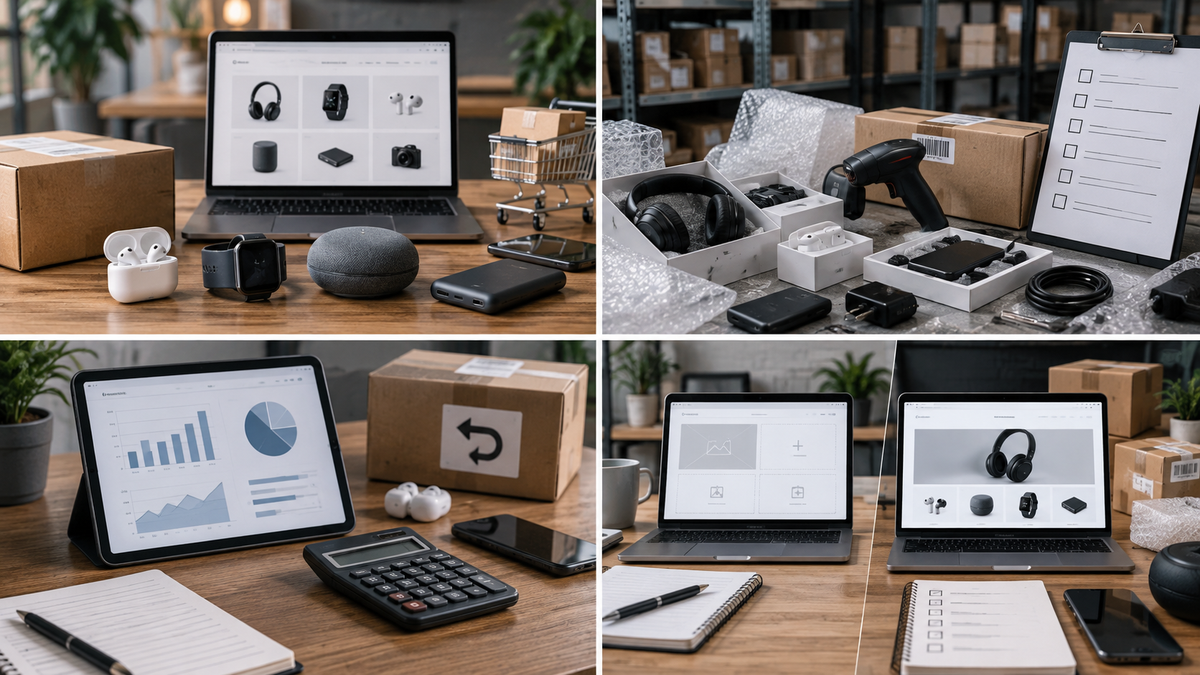
If you want to dropship electronics in 2026, the store is only one part of the job. The real work is choosing products with manageable return risk, finding suppliers you can test, pricing for shipping and refunds, and setting clear customer expectations. You can build that system from scratch or begin with a ready-made store foundation, but neither route removes the need to validate products, suppliers and demand.
What This Means for You
Electronics dropshipping can be attractive because you do not normally need to buy and warehouse a large quantity of stock before testing a product. But electronics also create risks that are easier to ignore in simpler categories: dead-on-arrival items, plug and voltage compatibility, battery shipping restrictions, warranty questions, fragile packaging, rapidly changing models and customers who expect technical support.
The sensible approach is to treat the store as infrastructure and the supplier relationship as an operating system. Before you spend heavily on ads, you should know what happens when a device arrives damaged, when a product goes out of stock, when a customer needs a replacement, and when your supplier changes a specification.
How to Dropship Electronics: How the Model Works
In a standard dropshipping model, a customer buys from your online store, you transmit the order to a supplier, and the supplier ships the product directly to the customer. Shopify's current dropshipping guidance describes several ways to source products, including supplier marketplace apps, direct supplier relationships and Shopify's own sourcing ecosystem. The important point is that you can sell without storing the inventory yourself, while still remaining responsible for the customer experience.
For electronics, that responsibility matters. Your customer bought from your store, not from the invisible supplier behind it. Product questions, delivery complaints, refunds and chargebacks arrive at your business first. Shopify's legal guidance also makes clear that merchants must comply with the laws and rules that apply to the products they sell and the regions where they sell them.
Source: Shopify Help Center — Dropshipping and Shopify legal guidance for dropshipping.
What Electronics Should You Dropship?
A beginner is usually better served by products that are easy to explain, easy to test and inexpensive to replace if something goes wrong. That does not mean the cheapest possible products. It means products where the risk is understandable.
- Accessories: stands, mounts, cases, cable organizers and desk accessories can be easier to support than complex devices.
- Charging and power accessories: potentially strong demand, but compatibility, certification and battery-related rules need careful checking.
- Audio accessories: earbuds, speakers and microphones can be visually marketable, but defect rates and sound expectations make sample testing important.
- Smart-home accessories: useful products with clear demonstrations can work well, but app support, connectivity and regional compatibility can create support questions.
- Wearable accessories: bands, stands and protective accessories may be operationally simpler than selling the core wearable device itself.
Avoid choosing a product only because it is trending. Ask whether you can explain the benefit in one sentence, whether the supplier can keep it in stock, whether you can get a sample, and whether the return economics still work if a small percentage of orders fail.

How to Choose Electronics Dropshipping Suppliers
Supplier selection is the most important operational decision in an electronics dropshipping business. Shopify's supplier guidance recommends looking for experienced suppliers, responsive support, efficient ordering, reliable inventory information and strong fulfillment processes. It also recommends placing test orders because some supplier qualities are difficult to judge until you see the order process yourself.
For electronics, add a stricter layer. Before relying on a supplier, test these five things:
- Order a sample to yourself. Check the product, packaging, accessories, instructions and actual delivery time.
- Confirm the exact model and specification. A listing image is not enough. Check plug type, voltage, dimensions, connectivity, included accessories and language where relevant.
- Ask for the damaged-item and warranty process. Find out who pays for replacements, whether evidence is required and how quickly the supplier responds.
- Check inventory updates. A supplier that suddenly runs out of a promoted item can waste ad spend and damage customer trust.
- Run a support test. Ask a real pre-sale question and a hypothetical fault question. Slow or vague responses before you send volume are a warning sign.
You can go deeper in EcomChief's guide to what “supplier included” actually means in a ready-made dropshipping store.
Work Out the Numbers Before You Advertise
Electronics can look profitable when you compare only the selling price with the supplier price. That is not enough. Your working margin also needs room for shipping, payment processing, refunds, replacements, apps, customer acquisition and other operating costs.
Use this simple planning formula:
Contribution before fixed costs = selling price − product cost − shipping − payment fees − expected refund/replacement cost − customer-acquisition cost.
For example, imagine a product sells for $80. If the product costs $42, shipping is $7, you reserve $5 for fees and expected returns, and acquiring the customer costs $18, the remaining contribution is $8. This is only a hypothetical example, not a benchmark or earnings claim. Your actual numbers can be very different.
Before you run ads, put your own assumptions into the EcomChief Dropshipping Profit Calculator. It is designed for planning and does not guarantee sales or profit.

Understand the Electronics-Specific Risks
Electronics can produce attractive product demos and strong purchase intent, but operational problems can become expensive quickly. The risks are manageable only when you design for them before launch.
- Dead on arrival: a device that does not work on arrival can create replacement cost, refund pressure and chargeback risk.
- Compatibility: plugs, voltage, operating systems, Bluetooth versions, connectors and regional standards can turn a normal order into a support problem.
- Batteries: products containing lithium batteries can face carrier and destination restrictions. Check the supplier's shipping method and the rules for every market you target.
- Warranty expectations: customers often expect electronics to have clear warranty support. Your policy must match what you can actually deliver.
- Fast product cycles: models change quickly. A product page can become inaccurate if the supplier substitutes a newer or different version.
- Fragile packaging: inadequate packaging can turn a good product into a high-refund product.
EcomChief already has a separate deep dive on DOA, supplier and chargeback risk when buying an electronics dropshipping store. That article is useful if you want a more detailed diligence checklist.
Flippa's current ecommerce due-diligence guidance also emphasizes verifying operations, customer acquisition, supplier relationships and other claims rather than relying on presentation alone. That principle applies whether you are building a store or evaluating an existing ecommerce asset. See Flippa's ecommerce due-diligence checklist.

Build From Scratch or Start With a Ready-Made Electronics Store?
Both routes can work. The better choice depends on whether you want maximum control over every setup decision or a faster way to reach product and marketing tests.
| Decision factor | Build from scratch | Ready-made starter asset |
|---|---|---|
| Store design | You choose and build every page and section. | Core storefront structure is already prepared. |
| Product setup | You research, import and organize products yourself. | A starting catalog and product structure may already be included. |
| Supplier setup | You identify and connect suppliers from zero. | Supplier details or integrations can be provided, but you should still test them. |
| Launch speed | Depends on your design and technical workload. | Usually reduces setup work so you can move sooner to validation. |
| Historical performance | None until you create it. | Do not assume revenue, customers, traffic or profit are included unless a listing explicitly proves they are. |
| Ongoing work | Marketing, support, supplier monitoring and optimization remain your responsibility. | The same ongoing work still remains your responsibility. |
Practical next step: if you prefer to skip much of the storefront setup, review EcomChief's ready-made electronics dropshipping store. Treat it as a starter business asset, not as an established revenue-producing company. Review the current listing for exact inclusions, then test the supplier and product assumptions yourself before scaling marketing.
The EcomChief Electronics Supplier Risk Scorecard
Use this simple scorecard before you approve a supplier or product for paid traffic. Score each item from 0 to 2: 0 = not verified, 1 = partly verified, 2 = verified with direct evidence. This is a decision aid, not a guarantee of supplier quality.
| Check | 0 points | 1 point | 2 points |
|---|---|---|---|
| Sample quality | No sample ordered | Sample seen indirectly | You tested the exact product |
| Fulfillment | No delivery test | Supplier estimate only | Test order tracked end to end |
| Specifications | Unclear or generic | Some details confirmed | Exact model, compatibility and contents confirmed |
| Returns and warranty | No clear process | Policy exists but untested | Process, cost and response path confirmed |
| Communication and stock data | Slow or unreliable | Manual but usable | Responsive support plus reliable stock updates |
Interpretation: 0–4 means you still have major unknowns. 5–7 means proceed only with small tests. 8–10 means the supplier has passed your basic launch checks, but you should keep monitoring real orders. A high score does not remove legal, safety, shipping or customer-service obligations.
A 7-Step Electronics Dropshipping Launch Sequence
- Choose one narrow product angle. Start with a defined use case rather than a random electronics catalog.
- Shortlist suppliers. Compare product specifications, shipping routes, support, inventory updates and return terms.
- Order samples. Test the product, packaging, instructions, charging, compatibility and delivery experience.
- Build or acquire the store foundation. Make product pages clear about what is included, compatibility and delivery expectations.
- Model unit economics. Include refunds, replacement risk and acquisition cost rather than looking only at markup.
- Launch a small traffic test. Test one product or collection before spreading budget across a large catalog.
- Review real order data. Track defects, delivery complaints, refunds, questions and supplier response times before scaling.
For buyer-side expectations about ownership, transfer and what a ready-made asset does and does not include, read the EcomChief Ready-Made Online Business FAQ.
Final Decision: When Electronics Dropshipping Makes Sense
If you want to dropship electronics, the model makes the most sense when you are comfortable managing product detail, supplier quality and customer expectations. The model can reduce upfront inventory exposure, but it does not remove product responsibility. The strongest beginner setup is usually narrow: a focused product angle, a supplier you have personally tested, margins that allow for problems, and a store that explains compatibility and delivery clearly.
If you want maximum control and enjoy building ecommerce infrastructure, start from scratch. If your priority is getting to product testing faster, a ready-made starter asset can remove much of the setup work while leaving the important business decisions in your hands.
Next step: view the ready-made electronics dropshipping store, check the current inclusions, then use the supplier scorecard above before committing meaningful ad spend. EcomChief does not guarantee sales, traffic, profit or business success; results depend on demand, pricing, marketing, supplier performance, customer service and execution.
Related reading
All articles


Free Online Business Calculators
Estimate costs, profits, ROI, affiliate earnings, and business value before you spend money.