90DayPlan
How to Scale Your Ready-Made Dropshipping Store in the First 90 Days
You just bought a ready-made dropshipping store—congratulations! Now comes the exciting part: scaling it to 2x, 3x, or even 10x the revenue. The first 90 days are critical. This is when you learn the business, optimize what works, and implement growth strategies that compound over time.
This comprehensive 90-day scaling roadmap shows you exactly how to grow your dropshipping business from day one. Whether you're earning $2,000/month or $20,000/month, these proven strategies will help you scale profitably.
Why the First 90 Days Matter
The first three months after buying a dropshipping store are make-or-break. This is when you:
- Learn the business: Understand operations, suppliers, and customers
- Maintain stability: Keep existing revenue flowing while you learn
- Identify opportunities: Find quick wins and growth levers
- Build momentum: Implement changes that compound over time
- Establish systems: Create processes for sustainable growth
Most successful buyers who scale 2-5x in their first year do it by executing a strategic 90-day plan.
The 90-Day Scaling Framework
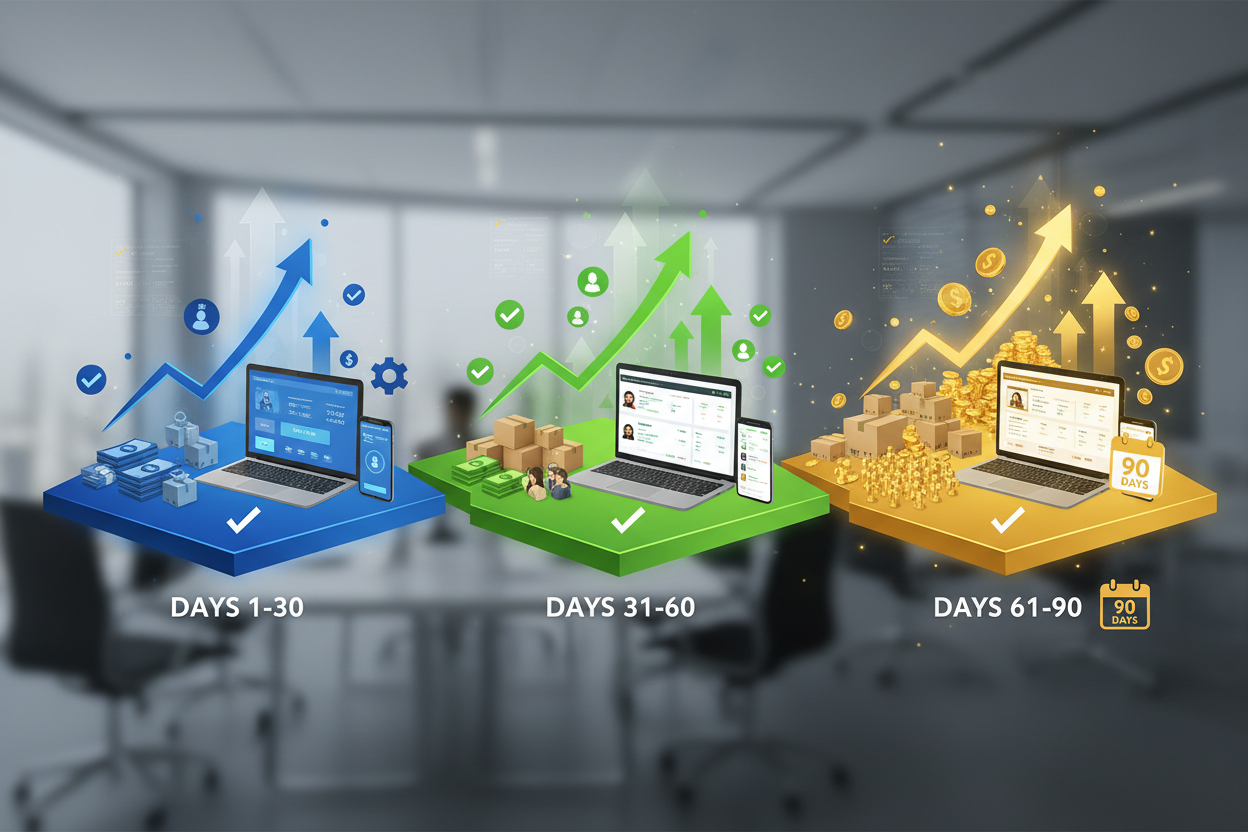
We'll break this into three 30-day phases:
- Days 1-30: Learn, Maintain & Optimize
- Days 31-60: Test, Expand & Improve
- Days 61-90: Scale, Automate & Systemize
Days 1-30: Learn, Maintain & Optimize
Goal: Understand the business, maintain existing revenue, and identify quick wins.
Week 1: Onboarding and Learning (Days 1-7)
Priority: Don't break what's working.
Daily tasks:
- Day 1-2: Complete seller handoff and training sessions
- Day 3-4: Review all SOPs and operational documentation
- Day 5-6: Contact suppliers and introduce yourself
- Day 7: Process your first orders and handle customer service
Key actions:
- Get access to all accounts (Shopify, Facebook Ads, email, analytics)
- Review Google Analytics to understand traffic sources
- Study Facebook Ads Manager to see what's working
- Read through customer service emails to understand pain points
- Order samples of top products to verify quality
- Document everything you learn in a notebook or doc
What NOT to do:
- Don't change ad campaigns yet
- Don't modify product pricing
- Don't redesign the website
- Don't add new products
Expected results: Maintain existing revenue while learning operations.
Week 2: Data Analysis and Baseline Metrics (Days 8-14)
Priority: Understand your numbers deeply.
Analyze these metrics:
- Revenue metrics: Daily/weekly/monthly revenue trends
- Profit margins: Product-level profitability
- Customer acquisition cost (CAC): How much to acquire each customer
- Lifetime value (LTV): Average customer spending
- Conversion rate: Percentage of visitors who buy
- Average order value (AOV): Average purchase amount
- Return rate: Percentage of orders returned
- Best-selling products: Top 20% driving 80% of revenue
Create a baseline dashboard:
- Document current performance in a spreadsheet
- Set up weekly tracking for key metrics
- Identify your most profitable products
- Calculate true profit after all expenses
Expected results: Clear understanding of business performance and profitability.
Week 3: Quick Wins and Low-Hanging Fruit (Days 15-21)
Priority: Implement easy optimizations that boost revenue immediately.
Quick win #1: Optimize Facebook ad budgets
- Pause underperforming ad sets (ROAS under 1.5x)
- Increase budget on winning ad sets by 20%
- Test increasing daily budget by $50-100 on best performers
Quick win #2: Improve email marketing
- Set up abandoned cart emails (if not already active)
- Create a welcome series for new subscribers
- Send a promotional email to existing list
- Segment customers by purchase history
Quick win #3: Increase average order value
- Add product bundles and upsells
- Implement "Frequently Bought Together" recommendations
- Create a free shipping threshold ($50-75)
- Add post-purchase upsells
Quick win #4: Reduce cart abandonment
- Add trust badges to checkout
- Display shipping times clearly
- Offer multiple payment options
- Add exit-intent popups with discount codes
Expected results: 10-20% revenue increase from optimizations alone.
Week 4: Customer Retention and Repeat Purchases (Days 22-30)
Priority: Turn one-time buyers into repeat customers.
Implement retention strategies:
- Post-purchase email sequence: Thank you, product tips, review request, repurchase reminder
- Loyalty program: Points for purchases, referrals, social shares
- Win-back campaigns: Re-engage customers who haven't purchased in 60+ days
- Product recommendations: Email complementary products based on past purchases
- VIP segment: Special offers for top 20% of customers
Expected results: 5-10% increase in repeat purchase rate.
Month 1 Results:
Typical outcomes:
- Revenue: +15-30% from baseline
- Profit margin: +2-5% from optimizations
- Customer acquisition: Maintained or slightly improved
- Operations: Smooth and stable
Days 31-60: Test, Expand & Improve
Goal: Test new strategies, expand product line, and improve conversion rates.
Week 5: Product Expansion (Days 31-37)
Priority: Add complementary products to increase AOV and revenue.
Product expansion strategy:
- Analyze customer behavior: What do customers buy together?
- Research competitors: What related products are they selling?
- Survey customers: Ask what else they'd like to buy
- Test 5-10 new products: Related to your best-sellers
- Create product bundles: Package complementary items together
Example: If you sell yoga mats, add yoga blocks, straps, towels, and bags.
Expected results: 10-15% revenue increase from new products.
Week 6: Conversion Rate Optimization (Days 38-44)
Priority: Turn more visitors into buyers.
CRO tactics:
- Improve product pages: Better images, detailed descriptions, video demos
- Add social proof: Customer reviews, testimonials, user-generated content
- Optimize mobile experience: 60-70% of traffic is mobile
- Simplify checkout: Reduce steps, add express checkout options
- A/B test headlines: Test different value propositions
- Add urgency: Limited stock indicators, countdown timers
Expected results: 0.5-1% conversion rate improvement (huge impact on revenue).
Week 7: New Marketing Channels (Days 45-51)
Priority: Diversify traffic sources beyond Facebook ads.
Test these channels:
- Instagram influencers: Partner with micro-influencers (10K-100K followers)
- TikTok ads: Test $20-50/day budget on TikTok
- Google Shopping ads: Set up product feed and test campaigns
- Pinterest ads: Great for visual products and lifestyle niches
- YouTube pre-roll ads: Video ads before relevant content
- Affiliate marketing: Recruit affiliates to promote your products
Budget allocation: Test each channel with $200-500 to validate performance.
Expected results: Find 1-2 new profitable channels to scale.
Week 8: Customer Service Excellence (Days 52-60)
Priority: Improve customer experience to boost reviews and retention.
Customer service improvements:
- Faster response times: Reply to inquiries within 2-4 hours
- Proactive communication: Send shipping updates and delivery confirmations
- Easy returns: Streamline return process to reduce friction
- Surprise and delight: Include thank you notes or small gifts
- Review generation: Automated review requests 7-14 days after delivery
Expected results: Higher review ratings, lower refund rates, more repeat customers.
Month 2 Results:
Typical outcomes:
- Revenue: +40-70% from baseline (cumulative)
- Conversion rate: +0.5-1% improvement
- Traffic sources: 2-3 profitable channels identified
- Product catalog: 10-20% larger with complementary items
Days 61-90: Scale, Automate & Systemize
Goal: Aggressively scale what works, automate operations, and build systems for sustainable growth.
Week 9: Aggressive Scaling (Days 61-67)
Priority: Pour fuel on the fire—scale winning campaigns.
Scaling strategy:
- Increase ad budgets: Scale winning campaigns by 20-50% weekly
- Expand audience targeting: Test lookalike audiences and new demographics
- Launch retargeting campaigns: Target website visitors who didn't buy
- Increase influencer partnerships: Work with 5-10 influencers simultaneously
- Boost top products: Focus ad spend on best-sellers
Scaling rules:
- Only scale campaigns with ROAS above 2.5x
- Increase budgets gradually (20% every 3-4 days)
- Monitor performance daily during scaling
- Be ready to pull back if performance drops
Expected results: 30-50% revenue increase from scaling alone.
Week 10: Automation and Delegation (Days 68-74)
Priority: Free up your time by automating and delegating.
Automate these tasks:
- Email marketing: Automated sequences for every customer journey stage
- Order processing: Auto-sync orders to suppliers (Oberlo, DSers, AutoDS)
- Inventory alerts: Notifications when products are low stock
- Review requests: Automated emails requesting reviews
- Social media posting: Schedule posts in advance
Delegate these tasks:
- Customer service: Hire VA for $600-1,200/month
- Ad creative design: Outsource to designer for $200-500/month
- Content creation: Hire writer for product descriptions and blogs
- Social media management: VA handles posting and engagement
Expected results: Reduce time commitment from 25 hours/week to 10-15 hours/week.
Week 11: Brand Building (Days 75-81)
Priority: Transform from generic store to recognizable brand.
Brand building tactics:
- Develop brand story: Create compelling "About Us" and mission statement
- Improve packaging: Custom branded packaging and inserts
- Build social media presence: Consistent posting and community engagement
- Create content: Blog posts, videos, tutorials related to your niche
- User-generated content: Encourage customers to share photos/videos
- Build email community: Valuable content beyond just promotions
Expected results: Higher customer loyalty, better retention, premium pricing power.
Week 12: Systems and Documentation (Days 82-90)
Priority: Document everything for sustainable, scalable operations.
Create SOPs for:
- Daily operations checklist
- Order processing workflow
- Customer service response templates
- Ad campaign setup and optimization
- Product research and testing process
- Supplier communication protocols
- Weekly/monthly reporting procedures
Build your growth dashboard:
- Track revenue, profit, CAC, LTV, conversion rate weekly
- Monitor ad performance across all channels
- Analyze product performance and trends
- Review customer feedback and reviews
Expected results: Scalable systems that work without you.
Month 3 Results:
Typical outcomes:
- Revenue: +100-200% from baseline (2-3x growth)
- Profit margin: Maintained or improved despite scaling
- Time commitment: Reduced by 40-60% through automation
- Systems: Documented and scalable operations
90-Day Scaling Results: Real Examples
Example 1: Home Decor Store
Starting point: $8,000/month revenue, $2,400/month profit
After 90 days: $22,000/month revenue, $6,600/month profit
Growth: 175% revenue increase, 175% profit increase
Key strategies:
- Scaled Facebook ads from $1,500/month to $5,000/month
- Added 15 complementary products
- Launched Instagram influencer partnerships
- Improved conversion rate from 1.8% to 2.6%
Example 2: Fitness Accessories Store
Starting point: $15,000/month revenue, $4,500/month profit
After 90 days: $38,000/month revenue, $11,400/month profit
Growth: 153% revenue increase, 153% profit increase
Key strategies:
- Launched TikTok ads generating 30% of revenue
- Created product bundles increasing AOV by 35%
- Implemented email automation driving 20% of sales
- Hired VA to handle customer service
Common Scaling Mistakes to Avoid
1. Scaling Too Fast
Increasing ad budgets by 100%+ overnight often crashes performance. Scale gradually (20% every 3-4 days).
2. Neglecting Profit Margins
Revenue growth means nothing if profit margins collapse. Monitor profitability closely during scaling.
3. Ignoring Customer Service
As you scale, customer service demands increase. Hire help before you're overwhelmed.
4. Not Testing New Channels
Relying on one traffic source is risky. Diversify across 2-3 profitable channels.
5. Forgetting to Document
Without systems and SOPs, scaling creates chaos. Document everything as you grow.
Tools and Apps for Scaling
Marketing and Ads:
- AdEspresso: Facebook ad optimization and testing
- Triple Whale: Analytics and attribution tracking
- Klaviyo: Email marketing automation
- Privy: Popups and conversion optimization
Operations and Automation:
- DSers or AutoDS: Automated order fulfillment
- Gorgias: Customer service helpdesk
- Loox: Photo reviews and social proof
- ReConvert: Post-purchase upsells
Analytics and Tracking:
- Google Analytics: Traffic and behavior tracking
- Hotjar: Heatmaps and session recordings
- Lifetimely: LTV and cohort analysis
Your 90-Day Scaling Checklist
Days 1-30:
- ✅ Complete seller training and handoff
- ✅ Analyze baseline metrics and performance
- ✅ Implement quick wins (ad optimization, email, AOV)
- ✅ Set up customer retention campaigns
Days 31-60:
- ✅ Add 5-10 complementary products
- ✅ Optimize conversion rate (CRO)
- ✅ Test 2-3 new marketing channels
- ✅ Improve customer service processes
Days 61-90:
- ✅ Aggressively scale winning campaigns
- ✅ Automate operations and delegate tasks
- ✅ Build brand and community
- ✅ Document systems and SOPs
Beyond 90 Days: Continued Growth
After your first 90 days, continue scaling with:
- International expansion: Target new countries and markets
- Product line expansion: Launch your own branded products
- Team building: Hire specialists for ads, content, operations
- Multiple stores: Launch additional stores in new niches
- Exit strategy: Build to sell at 3-5x higher valuation
Ready to Buy and Scale Your Dropshipping Store?
Now you have the complete 90-day roadmap to scale your ready-made dropshipping store from day one. The strategies in this guide have helped hundreds of buyers 2-5x their revenue in the first three months.
Browse our marketplace of verified dropshipping businesses ready to scale:
- Ready-Made Dropshipping Stores for Sale - Proven products, established suppliers, ready to scale
Looking for other business models? Explore our full marketplace:
- Affiliate Websites for Sale - Maximum passive income potential
- Amazon FBA Businesses for Sale - Established brands with inventory
- Digital Agencies for Sale - Active clients and recurring revenue
Every listing on our online business marketplace includes verified financials, traffic analytics, and growth potential analysis—giving you everything you need to execute this 90-day scaling plan.
Stop building from scratch. Buy a proven dropshipping store and scale it to 2-3x revenue in your first 90 days. Your growth journey starts today.
Related reading
All articles


Free Online Business Calculators
Estimate costs, profits, ROI, affiliate earnings, and business value before you spend money.