

AiAgency
AI Businesses for Sale: How to Evaluate AI Agencies and SaaS Assets
AI businesses for sale require proper due diligence. Compare AI agencies, SaaS apps and white-label software with 12 checks covering ownership, code, licensing, API costs, privacy, handover and customer demand.
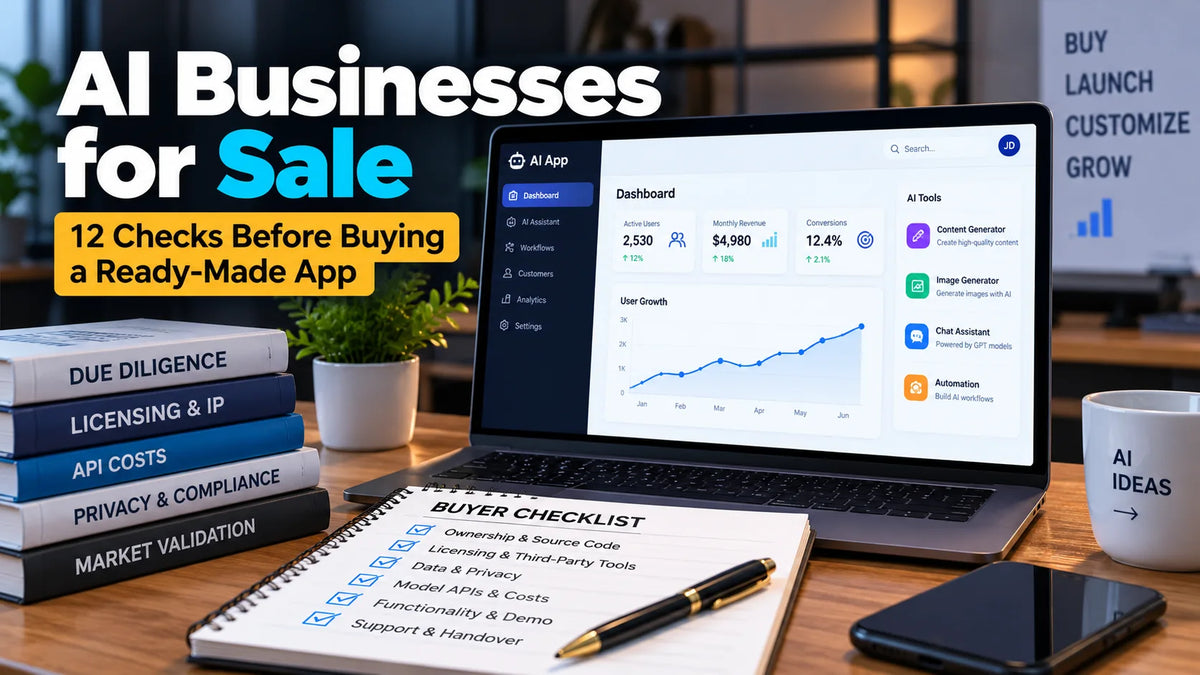
Updated October 31, 2026. An AI business for sale can mean a working software asset, permission to resell a third-party app, an agency website, or an established company with paying customers. Those are very different purchases. Before spending money, identify precisely what transfers, what you must maintain, and how you will acquire customers.
Illustration note: The featured illustration uses fictional dashboard figures and does not depict actual customers, revenue, or results from any app for sale.
Quick answer: When evaluating AI businesses for sale, check ownership, source code, commercial licensing, data rights, model dependencies, operating costs, product quality, privacy, handover, support, customer acquisition and demand. A polished demo or the words “ready-made” are not evidence of revenue or profitability.
What are you actually buying: a software asset or an operating company?
An asset purchase might include software code, a website, domain, design files, documentation and specified commercial rights. It may have no customers, transaction history, sales process or historical earnings. You are buying a foundation from which to launch a business.
An established AI software business should come with independently verifiable records of customers, revenue, expenses and operating performance, subject to the sale agreement. It also raises additional questions about transferring contracts, subscriptions, accounts, employees and intellectual property.
Other common models include an AI automation agency that sells implementation services and a white-label SaaS arrangement where you put your brand on another supplier’s software. With white-label licensing, ownership of the underlying code is not automatic. Ask which rights are granted in writing.
At EcomChief, the ready-made software and apps collection describes source-code handover, branding and commercial resale rights. However, check the terms and deliverables for the specific listing you are considering; a software purchase should never be mistaken for an acquisition of existing paying customers.
The 12 checks before buying a ready-made AI app
Use these checks whether you are assessing a low-cost starter app or a larger revenue-producing software acquisition. Request evidence for each important claim rather than accepting a sales description alone.
1. Confirm ownership and the asset schedule
Ask for a written list of the domain, repository, source files, design assets, database structure, deployment configuration and associated intellectual-property rights. Determine whether you receive full ownership, an assignment, a license or access to a hosted service. Check for exclusions and third-party components that cannot be transferred.
2. Inspect source code and deployment requirements
Confirm that the app can be installed in an environment you control. Ask which framework, database, hosting provider, version-control repository and external services it requires. A demonstration hosted on the seller’s account is not proof that the buyer can deploy and operate the product independently. If necessary, use a qualified developer to inspect the code.
3. Read commercial, white-label and component licenses
Check whether you may rebrand the software, modify it, host multiple customer instances, charge subscriptions or resell copies. Examine any open-source dependencies, purchased templates, third-party datasets and proprietary model terms. “Unlimited resell rights” should be documented, not inferred from a product headline.
4. Verify data rights and database ownership
Establish what customer records, uploaded files, prompts, analytics, logs and training or reference datasets are included. Ask how that data was collected and whether it can lawfully be transferred. If there is no customer data, that is normal for a new starter asset—just ensure the listing says so. Do not purchase or transfer private user information without an appropriate legal basis.
5. Map model providers and API dependencies
Identify every model API, third-party integration, authentication system and external service. Ask what happens if a provider changes its pricing, usage limits, model behavior or availability. Confirm whether the buyer must create new API keys and whether the app still works after the seller’s credentials are removed.
6. Calculate unit economics, not just subscription revenue
Estimate costs per active customer: AI input/output usage, hosting, storage, payment processing, email, monitoring, refunds and support. Include fixed monthly fees and customer acquisition separately. Model costs can rise with heavy usage; the provider’s official API pricing page is a useful example of why actual model choice and usage matter more than a guessed flat rate.
7. Test real product functionality
Run the live demo yourself. Test sign-up, login, core workflow, empty states, incorrect inputs, mobile display and account deletion where applicable. Confirm that outputs are helpful, not merely impressive in a scripted demo. Request a test environment if a feature could expose or change real user data.
8. Assess privacy, security and AI-specific risks
Review how secrets are stored, whether accounts are isolated, how access permissions work, where data is retained and how incidents are handled. For AI-enabled apps, include prompt-injection exposure, sensitive-information disclosure and unsafe automated actions. The NIST AI Risk Management Framework offers a voluntary risk-management reference; OWASP’s guidance describes common LLM application security risks.
9. Demand a practical handover process
Have the seller explain the sequence for transferring the domain, code, admin access, database, hosting, payment configuration and service accounts. Confirm what must be created in your own name. Ask for setup documentation and a clean demonstration of deployment using buyer-controlled credentials.
10. Clarify post-sale support
Separate initial setup assistance from ongoing bug fixes, hosting administration, product development, security patches and third-party subscription costs. Get the support duration, contact method, response expectations and exclusions in writing. “Lifetime support” and “30-day developer support” can describe different commitments, so establish which applies to your purchase.
11. Assess the marketing and distribution plan
Even technically sound software may fail commercially if you cannot reach customers. Identify the target industry, buying decision-maker, main acquisition channel and estimated cost of generating a qualified lead. Consider whether you can demonstrate the app through a landing page, direct outreach or partnerships before investing heavily in advertising.
12. Validate genuine customer demand
Define the job the app performs and what buyers currently use instead. Interview prospective customers, study competing products and ask whether anyone will pay for the result. If buying an established operation, request customer retention, renewals, refunds, support burden and payment records. If buying a starter app, assume demand remains unproven until you test it.

A simple AI app cost-per-customer example
Consider a hypothetical app charging $29 per customer per month. Assume $3.50 in model/API usage, $2 in hosting and infrastructure, $1.20 in payment costs and $2.50 in support time per paying customer. These are example inputs, not EcomChief results or a forecast of your costs.
| Illustrative monthly item | Per customer |
|---|---|
| Subscription charged | $29.00 |
| AI model usage | $3.50 |
| Hosting and services | $2.00 |
| Payment processing | $1.20 |
| Support allocation | $2.50 |
| Contribution before fixed costs and acquisition | $19.80 |
At 50 paying customers, that scenario produces $1,450 in subscription revenue and $990 in contribution before fixed software subscriptions, marketing, development, tax and other expenses. It is not net profit. If customers use more AI tokens than expected, contribution falls; if acquisition costs exceed the lifetime contribution of a customer, the business may be uneconomic.
For an asset that already claims revenue, replace every assumption with invoices, payment statements, observed usage logs and actual support data. For an unlaunched app, build conservative, expected and high-usage scenarios.
Live demo tests that reveal problems early
Ask the seller for a working demonstration and test the complete core workflow rather than only looking at the homepage.
- Create a fresh account: check signup, verification, sign-in, password reset and user permissions.
- Complete the primary task: test realistic inputs and whether the result would actually save a customer time or money.
- Try failure cases: invalid files, long prompts, empty inputs, rate limits and a disconnected API should produce understandable errors.
- Check data isolation: one user must not be able to see another customer’s records or private outputs.
- Inspect mobile usability: test on a narrow screen, including forms, navigation and result views.
- Repeat with your own credentials: verify that the app can operate independently of the seller’s accounts after handover.
Questions to send the seller before you pay
- What exactly is transferred, and which files or accounts remain with you?
- Do I receive the complete source repository, installation instructions and commercial resale rights?
- Which paid APIs, models, databases, hosting plans and other subscriptions must I arrange?
- Can I rebrand, modify, host, charge subscriptions and sell multiple installations?
- Has the app been deployed from a fresh environment using buyer-owned accounts?
- What is included in post-sale support, and what is explicitly excluded?
- Does the offer include any customers or historical revenue? If so, what independent evidence supports that?
- Can I test the complete workflow and review the license terms before payment?
Red flags versus ordinary launch-stage risks
| Serious warning sign | Ordinary risk to plan for |
|---|---|
| Seller refuses to explain ownership or license terms | A new app has no customers yet |
| Demo needs undisclosed seller-only credentials | Buyer must pay their own hosting and API fees |
| Guaranteed profit claims without evidence | Some setup and customer acquisition work is required |
| Sensitive data is transferred without permission | AI output needs monitoring and improvements |
Be especially cautious about claims of guaranteed passive income. The US Federal Trade Commission has challenged deceptive AI-related marketing and business-opportunity claims. Due diligence should rely on actual documents and tests, not promises.
How to choose a niche before buying an AI or SaaS asset
Start with a narrow workflow and an accessible customer segment. A booking tool for small service businesses, for example, should be judged on appointment reliability, ease of setup and the ability to get in front of business owners—not on how often the words “AI” or “automation” appear in the description.
Compare three candidate niches by problem urgency, ability to reach customers and ongoing service burden. Talk to five potential buyers in the best niche. Ask how they currently complete the task, what the inconvenience costs and whether they would trial a simpler solution. Five conversations do not prove market demand, but they can quickly reveal a weak premise.
If you prefer sales and service delivery over software maintenance, an agency business model may be a closer fit. If you prefer creating and distributing a product, compare the available software assets. For a separate discussion about assessing an established company’s earnings, see How to Value an AI Business: Metrics Buyers Should Check.
Frequently asked questions
Does a ready-made AI app include customers and recurring revenue?
Not unless the listing and sale agreement explicitly say so. A ready-made software asset is usually a launch foundation; an established revenue-producing company is a different kind of transaction.
Can I buy white-label SaaS without knowing how to code?
Possibly, if the software is properly deployed and the seller provides appropriate handover documentation. You will still need to understand subscriptions, customer support, basic operations and who can maintain the app when something breaks.
What ongoing costs should I budget for?
Hosting, AI model calls, databases, storage, payments, email, monitoring, compliance, maintenance and marketing may all apply. Ask for required and optional services separately and forecast heavy usage as well as normal usage.
Is full source code the same as unlimited resale rights?
No. Possession of code does not automatically grant unlimited reproduction, sublicensing, commercial distribution or rights to third-party libraries. Confirm the contract and component licenses.
What should I do immediately after handover?
Transfer ownership, rotate credentials, configure billing under your own accounts, deploy a clean copy, run security and workflow tests, document the system, and start with a small customer-validation experiment.
Before you buy: the final checklist
Make sure you can answer five questions in one sentence each: What do I own? Does it really work? What does it cost to serve a customer? How do I reach that customer? What happens if the seller disappears? Unclear answers mean more diligence is needed.
Next step: Browse EcomChief’s ready-made apps and software businesses, compare the actual listing terms, and review what is included with a software purchase. A ready-made app can save development effort, but it is not a promise of customers, profitability or return on investment.
Related reading
All articles


Free Online Business Calculators
Estimate costs, profits, ROI, affiliate earnings, and business value before you spend money.