
ReadyMadeApps
What’s the License? Can I Resell SaaS Starter Templates?
Paying for a SaaS template does not always mean you own the code the way you think. Here’s how to understand license types, avoid the “unlimited projects” trap, and protect yourself before...
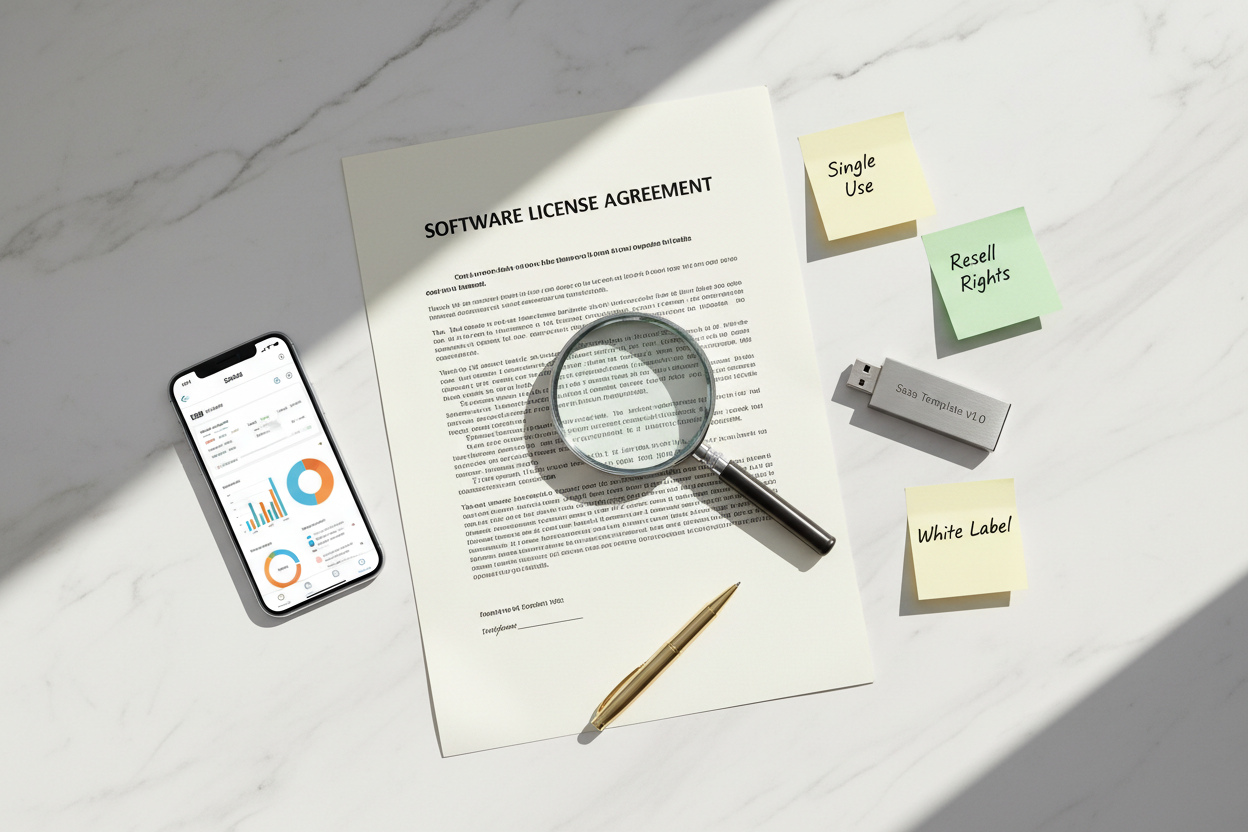
What’s the License? Can I Resell SaaS Starter Templates?
BLUF (Bottom Line Up Front)
Quick Answer: Buying a SaaS starter template does not automatically mean you own the code in a way that lets you clone it, resell it, or reuse it for client work. Unlike a readymade dropshipping for sale business, where ownership of the asset stack is usually more direct, software purchases are often governed by license terms that control exactly what you can do. Before building a business on any template, verify whether you have single-use rights, commercial deployment rights, or true resale rights.
Let’s talk about a mistake a lot of smart buyers make.
They buy a clean-looking Micro-SaaS or one of those polished SaaS starter templates, tweak the colors, swap the logo, launch it, and then assume they now fully own the whole codebase forever.
That’s where things get dangerous.
Because in software, paying for something does not always mean you own it the way you think you do. Sometimes you did not buy the software itself. You only bought permission to use it in a very specific way. And if you build your whole business on the wrong assumption, you can walk straight into a copyright mess later.
The Code Ownership Illusion
Verdict: A paid template can still be legally restrictive. If you assume too much, the business breaks at the legal layer, not the technical one.
Imagine this.
You buy a readymade AI SaaS template for $500. It looks great. You customize the UI, launch it, and everything works. Then a month later, a client offers you $10,000 to build them a similar version. So you reuse the exact same template and deploy a second copy for them.
Then the original creator finds out and hits you with a copyright complaint.
That’s the moment the illusion breaks.
You thought you bought software. In reality, you may have only bought a single-use license. Buyers ask all the time, “What am I actually buying?” And that is exactly the right question, because sellers love marketing features while staying vague about intellectual property rights.

Physical Businesses and Software Do Not Work the Same Way
Key takeaway: In ecommerce, you usually buy the business asset directly. In software, you often buy permission, not ownership.
This is where a lot of confusion comes from.
If you buy a readymade dropshipping for sale business, or an affiliate marketing business for sale, you are usually buying the actual asset stack: the domain, the customer list, the site, and the front-end business itself. Ownership is much more direct.
And when people look at amazon businesses for sale, they often expect the same kind of clear ownership around inventory and brand registry, even though those models come with their own financial traps. That is why our breakdown on this topic is worth keeping in mind when comparing business models:
Paper Rich, Cash Poor: The FBA Profit Trap Buyers Miss
Software templates are different.
In most template deals, you are not buying the copyright to the source code. You are buying a license that tells you exactly how many times you can use it, where you can use it, and whether you can make money from distributing it.
That is the real legal framework behind the purchase.
The Three License Buckets You Need to Understand
Verdict: Before you buy any template, you need to know which permission bucket it lives in — single-use, commercial, or true resell rights.
Before you buy any template or readymade app, you need to figure out which bucket it falls into.
1) Single-use license
This is the most restrictive common option.
You can build one end product for yourself. That usually means one project, one deployment, one business use. But you cannot turn around and use that same template to build products for paying clients, and you definitely cannot resell the raw code.
2) Extended or commercial license
This is where people start getting confused.
Here, you may be allowed to charge users for access to the app you built. So yes, you can run a SaaS with subscriptions. But that still does not automatically mean you can resell the source code or deploy the same template over and over for different client projects.
3) Resell or white-label license
This is the valuable one.
A proper white-label or resell license gives you the legal right to clone, rebrand, deploy across multiple projects, and in some cases even sell the finished app to someone else. That is a completely different level of permission — and it should be priced and documented differently too.
The “Unlimited” Wording Trap
Key takeaway: “Unlimited projects” sounds broad, but it often does not mean commercial resale rights.
This is where buyers get burned.
A seller might write something like, “Unlimited projects!”
Sounds amazing. But that phrase can mean almost anything.
It might only mean unlimited personal projects under your own control. It might not mean unlimited commercial resale. It might not allow agency use. And it might not allow you to sell a deployed copy to a third-party buyer.
So if your actual plan is to flip the app, resell it, or use it for clients, you need to ask one question directly:
Does this license give me the legal right to resell the compiled application to a third-party buyer?
If that answer is not crystal clear, do not assume anything.
The IP Audit You Should Run Before You Buy
Verdict: The license terms matter more than the feature list. Verify them before you build your whole business on the wrong assumption.
This part matters more than the feature list.
Start by checking the repository for a LICENSE.md file. That is often the fastest place to understand the real rules. If the project is under MIT, your freedom is usually broad. If it uses a proprietary license, then the seller’s exact terms control what you can and cannot do.

Then take the legal wording into the sale documents. Do not rely on a casual email like, “Yeah, you can sell it.” Put the deployment rights into the Asset Purchase Agreement (APA) in plain English. Define what counts as an end product, how many times it may be deployed, and whether resale rights are included.
That kind of precision is exactly what keeps you out of infringement territory later. And if you’ve ever seen how strict compliance rules can get in adjacent digital models, it feels very similar to the care required when handling Amazon affiliate transitions, where the backend rules matter far more than the surface appearance.
Verify Before You Deploy
Key takeaway: Sometimes you can resell. Sometimes you absolutely cannot. The whole business can hinge on that difference.
That’s the bottom line, friend.
Do not assume that buying a SaaS template means you can clone it endlessly, resell it, or use it for any commercial purpose you want. Sometimes you can. Sometimes you absolutely cannot.
The whole business can hinge on that distinction.
At Ecom Chief, this is exactly why licensing clarity matters. Buyers need to know whether they are getting a one-time use asset, a commercial deployment license, or real white-label rights they can scale and sell confidently.
If you’d rather stick to physical-asset models where ownership is more straightforward, you can explore our Amazon FBA Business For Sale collection, including our Amazon Organic Health & Beauty FBA Business listing. Those businesses come with different risks, but the ownership model is usually much easier to understand than software licensing.
Amazon Organic Health & Beauty FBA Business
So before you build your whole plan on someone else’s code, stop and ask the one question that actually matters:
What’s the license — and can I legally resell this?
Video Recommendation
Verdict: This is a strong follow-up if you want a clearer understanding of contracts, IP protection, and the exact legal boundaries behind software ownership.
This video is a strong follow-up because TK Kader goes straight into the legal side founders usually ignore until it hurts: contracts, IP protection, and the boundaries that define what is actually yours. It fits this topic perfectly because the whole problem here is not technical — it’s legal clarity.
If you want to avoid building on assumptions and protect yourself from future IP disputes, this is exactly the kind of watch that helps.
Related reading
All articles


Free Online Business Calculators
Estimate costs, profits, ROI, affiliate earnings, and business value before you spend money.