The Real Pros and Cons of Buying a Premade Business
Buying a premade online business can save time and reduce setup stress, but it is not guaranteed income. This guide explains the real pros, cons, risks, and checks before you buy.
Bluf
Quick Answer: Buying a premade online business can save time, reduce setup stress, and help beginners launch faster. However, buyers must understand the risks, including traffic claims, supplier quality, profit expectations, and ongoing marketing responsibilities.
If you are asking what are the pros and cons of buying a premade online business, the honest answer is simple: it can be a smart shortcut, but it is not a magic income button.
A premade online business helps you skip the slow setup stage. Instead of spending weeks building a website, choosing a niche, adding products, creating pages, setting up branding, and figuring out supplier or affiliate structures, you can buy a launch-ready asset and focus on marketing.
But this is where many beginners get confused. A premade business is usually a foundation. It gives you the structure, design, assets, and handover support. It does not guarantee sales. Revenue depends on your traffic, offer, pricing, niche, consistency, and how well you operate the business after purchase.
At EcomChief, buyers can explore ready-made online businesses, including ready-made dropshipping stores, Amazon affiliate-style businesses, affiliate businesses, digital agency websites, AI agency businesses, and ready-made apps and SaaS-style assets.
This guide gives you the honest version before you buy.
What Is a Premade Online Business?
A premade online business is a business asset that has already been built before it is sold to a buyer. It may include a website, branding, pages, product structure, supplier setup, affiliate links, service packages, or app/software assets depending on the business model.
For example, a ready-made dropshipping store may include a Shopify website, product pages, niche branding, supplier setup, and basic launch guidance. An Amazon affiliate business may include a content-style website designed to send buyers to Amazon products and earn commissions. A ready made digital agency website may include service pages, package structure, lead forms, and agency-style branding.
The important thing to understand is this: a premade online business is not the same as buying an established business with verified revenue history. In most cases, you are buying a launch-ready foundation, not a proven income stream.
That is not a bad thing. It just means your expectations must be realistic. You are paying to save setup time, reduce technical stress, and start with a cleaner foundation. You still need to market, test, improve, and manage the business after purchase.
Before buying, always check what is included in the sale and how the handover process works.
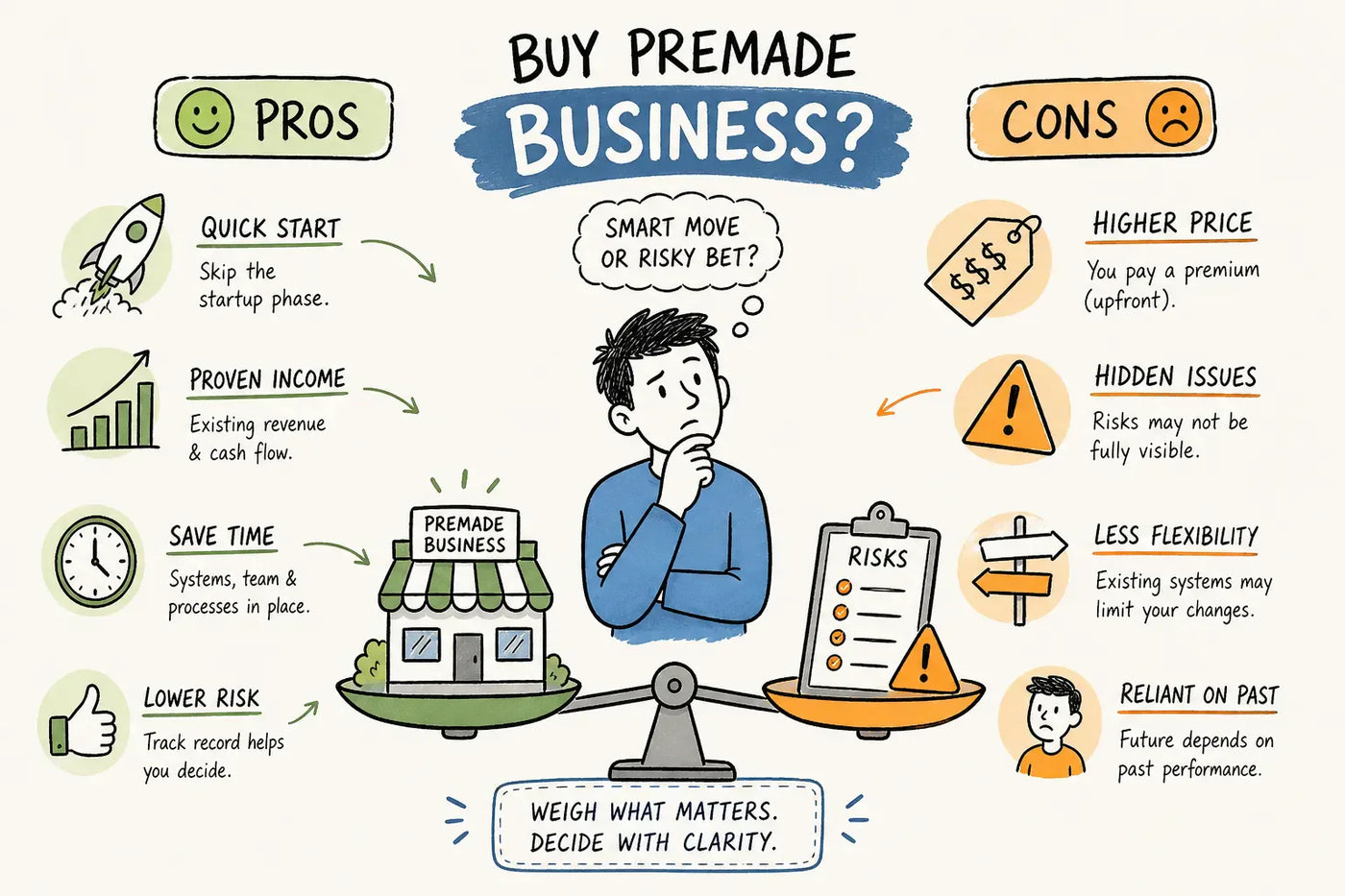
Main Pros of Buying a Premade Online Business
The biggest advantage is speed. Building an online business from scratch takes time. You need to choose the niche, buy a domain, design the website, write copy, source products, create pages, set up basic systems, and prepare the launch. For a beginner, that can easily take weeks.
With a premade online business, the setup work is already done for you. That means you can move faster into the part that actually matters: getting traffic, testing offers, improving conversions, and learning how the business works.
Another major benefit is lower technical pressure. Many beginners want to start an online business, but they get stuck trying to build the website. They waste too much time on design, apps, product uploads, legal pages, menus, and layout decisions. A ready-made business helps remove that friction.
You also get business model choice. Some buyers want ecommerce and product sales, so a ready-made electronics dropshipping store or pet dropshipping store may suit them. Others prefer content and commissions, so an Amazon affiliate business may be a better fit. Buyers who like client services may prefer an AI agency business or digital agency website. Buyers interested in no code saas starter kits, cheap saas businesses for sale, or buy micro saas boilerplate options may prefer SaaS-style assets or ready-made apps.
The final benefit is confidence. A proper premade business should give you a clearer starting point. You are not staring at a blank screen. You have a website, structure, pages, and a launch direction. That can make a big difference for beginners who want to start but feel overwhelmed.

Main Cons of Buying a Premade Online Business
The main downside is that a premade online business usually does not come with proven sales history. Unless the seller clearly provides verified traffic, revenue, and customer data, you should treat the business as a new asset.
That means you cannot assume it will make money just because it is built. You still need to drive traffic. You still need to test ads, improve offers, create content, post on social media, manage customer questions, and keep the store or website updated.
Another risk is supplier or platform dependency. If you buy a dropshipping store, the supplier setup matters. If products become unavailable, shipping times change, or prices increase, you need to manage that. If you buy an affiliate business, your income depends on your affiliate program terms and your ability to generate traffic. If you buy a SaaS-style asset, you need to understand the app, support requirements, and technical handover.
There are also ongoing costs. Even if EcomChief charges a one-time purchase fee for the business asset, running an online business can still involve Shopify fees, domain renewal, hosting, apps, email tools, advertising, or freelancer support depending on the model you choose.
The biggest mistake is expecting passive income from day one. A premade online business can save you setup time, but it does not remove the work of growing the business. EcomChief is clear in its Help Center that no honest business can guarantee sales because results depend on marketing.
Premade Online Business vs Starting From Scratch
Starting from scratch gives you full creative control, but it also takes more time, more decision-making, and more technical effort. You need to build every part of the business yourself or hire people to do it for you.
That can work if you have experience, a clear niche, and enough time. But for many beginners, the build stage becomes the reason they never launch. They spend weeks changing logos, themes, colors, product titles, and pages, but they never actually start marketing.
A premade online business is different. It gives you a working foundation faster. You can still edit the branding, improve the copy, add products, change offers, and build your own marketing system later. But you start from a finished base instead of a blank page.
This is why a premade business can make sense for solopreneurs, remote workers, digital marketers, side hustlers, and beginners who want to learn by operating instead of spending months building.
For a deeper comparison, read Ready-Made vs Build From Scratch: Which Online Business Wins in 2026? and How to Start an Ecommerce Business Faster With a Ready-Made Store.
What to Check Before Buying One
Before you buy any premade online business, check exactly what transfers to you. Do not rely on vague promises. A professional listing should clearly explain what you receive and how the ownership handover works.
Here are the main things to check:
- Do you receive full website or store access?
- Is the domain included or connected?
- Are branding assets included?
- Are supplier details included where relevant?
- Are product pages, legal pages, and core pages already prepared?
- Is there a handover guide or support after purchase?
- Can you preview the business before buying?
- Are any income claims backed by real proof?
- Are ongoing costs clearly explained?
- Does the seller clearly say that sales are not guaranteed?
For EcomChief buyers, useful pages to review before purchase include What’s Included, Order & Handover, and the Help Center.
If you are buying an ecommerce store, check the niche and product direction. If you are buying an agency business, check the service pages and package structure. If you are buying an app or SaaS-style asset, check what files, access, usage rights, and support are included.

Common Red Flags to Avoid
Some red flags are easy to spot if you know what to look for. The biggest one is guaranteed income. Be careful with any seller who promises that you will make a fixed amount of money after buying.
No one can honestly guarantee that a new owner will generate sales. Traffic, ads, content, market timing, pricing, and execution all matter.
Another red flag is unclear handover. If the seller cannot explain what happens after payment, what access you receive, or how ownership is transferred, slow down. You should understand the process before you buy.
Also be careful with listings that only focus on hype. A good premade business listing should explain the business model, what is included, who it is for, and what the buyer needs to do after purchase.
Watch out for these signs:
- Guaranteed profit claims
- No clear ownership transfer process
- No explanation of ongoing costs
- No product, supplier, or business model clarity
- No support or handover guidance
- No live preview or clear business details
- Pressure to buy without reviewing the details
A premade online business should make starting easier, not confusing. If the seller makes the purchase feel unclear, that is a warning sign.
Who Should Buy a Premade Online Business?
A premade business is best for people who want a faster starting point and understand that marketing still matters.
It can be a good fit if you are a beginner who wants to avoid technical setup. It can also work well if you are a solopreneur, remote worker, digital marketer, freelancer, or side hustler who wants to test an online business without spending months building from scratch.
A ready-made dropshipping store may suit someone who likes visual products, social media, paid ads, and ecommerce. An Amazon affiliate business or affiliate site may suit someone who likes SEO, content, product reviews, and search traffic. A ready made digital agency website may suit someone who wants to sell services, outreach to local businesses, or build monthly recurring revenue. An AI agency business may suit someone interested in automation, AI tools, and business services.
If you want software-style assets, you can explore ready-made app assets and SaaS-style opportunities. These are better for buyers who like digital products, systems, demos, and improving software-based offers over time.
The best buyer is not someone looking for “free money.” The best buyer is someone who wants a shortcut through setup and is willing to do the work after launch.

Who Should Not Buy One?
A premade online business is not for everyone. If you expect guaranteed income, you should not buy one. If you do not want to learn marketing, customer service, content, ads, or basic operations, this model will frustrate you.
You should also avoid buying if you have no time to work on the business. Even a simple business needs attention. You may need to update pages, test ads, answer customer questions, write content, review products, monitor traffic, or improve your offer.
It may also not be the right fit if you want a fully established company with verified revenue, staff, financial statements, and years of operating history. That type of acquisition is different and usually costs much more.
A premade business is better for people who want a lower-cost launch foundation, not for people who want to buy guaranteed cash flow.
So before buying, ask yourself honestly:
- Do I have time to work on this weekly?
- Am I willing to learn basic marketing?
- Do I understand that sales are not guaranteed?
- Can I afford the normal running costs?
- Do I like the niche or business model?
- Am I buying this as a real business, not a lottery ticket?
If the answer is yes, a premade online business can be a practical starting point.
Final Thoughts
The honest verdict is this: buying a premade online business can be worth it if you understand what you are actually buying.
You are buying speed. You are buying structure. You are buying a launch-ready foundation. You are reducing the stress of building everything from zero. But you are not buying guaranteed sales, guaranteed profit, or a business that grows without effort.
For beginners, that can still be a very smart trade-off. Instead of spending weeks stuck in setup mode, you can start with a ready-made online business and focus on learning traffic, conversions, content, ads, and customer experience.
If you want ecommerce, explore ready-made dropshipping stores. If you prefer commission-based models, review Amazon business options or affiliate businesses. If you want a service-based model, check digital agencies or the AI agency business for sale. If you want software-style assets, explore ready-made apps and SaaS-style businesses.
The safest approach is simple: choose a model you understand, review what is included, avoid unrealistic income claims, and treat the purchase as the beginning of the business, not the finish line.
Related reading
All articles


Free Online Business Calculators
Estimate costs, profits, ROI, affiliate earnings, and business value before you spend money.