
Solopreneur
The Mental Model I Use to Decide Which Project Gets Today's Attention
The hardest daily decision in a solo business is not what to do — it is which of the fifteen things that all feel important gets your attention today. Most solopreneurs answer...
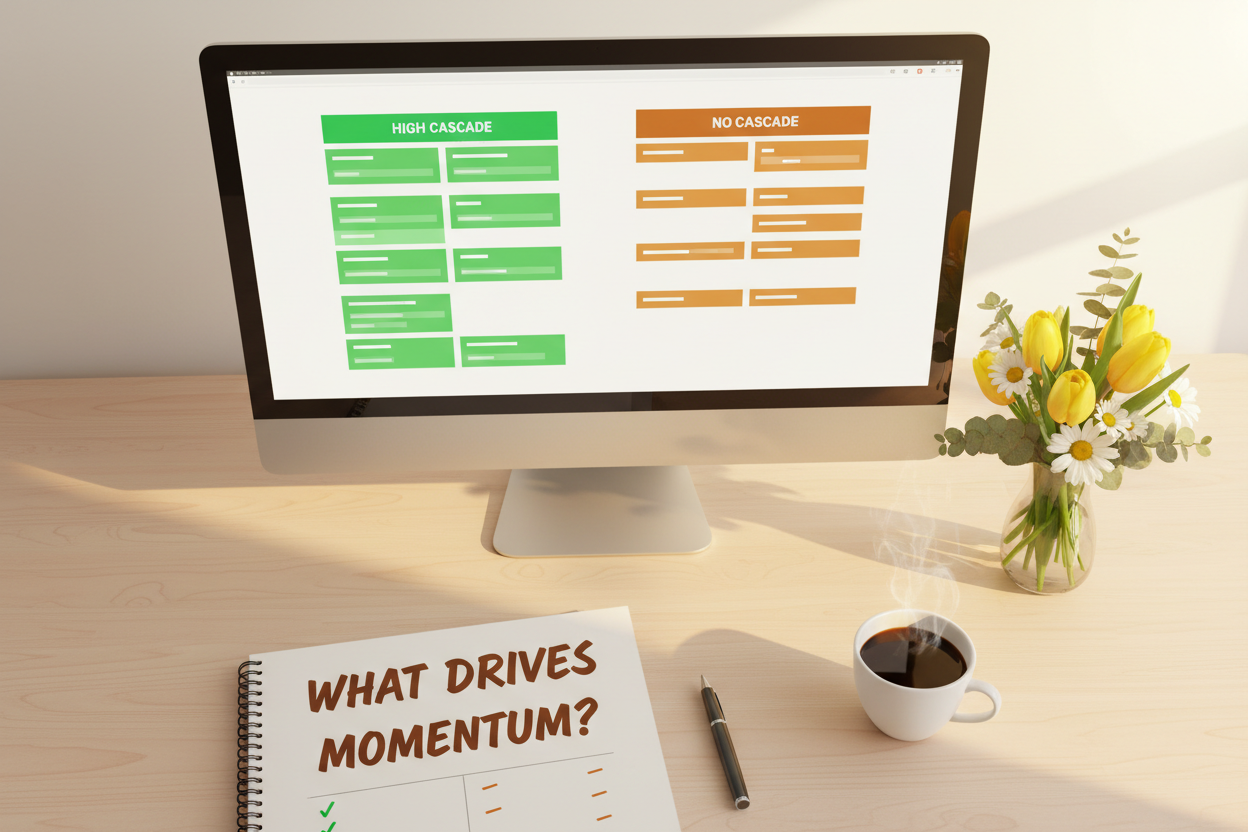
Quick Answer: To prioritise as a solopreneur, replace urgency feeling with a single cascade question — "if I don't do this today, what breaks or stalls in another part of the business?" Tasks that cascade into other workstreams if left undone are genuine priorities. Tasks that don't cascade fit the rotation schedule and can wait their slot. This single mental model has made more good daily decisions for EcomChief than any task management system, productivity framework, or time-blocking method I've ever tried — and it takes about thirty seconds to apply.
I used to start every day by opening my task list and feeling immediately overwhelmed. Fifteen things across six workstreams, all of which had some legitimate claim on today's attention, none of which could wait indefinitely. A store build mid-section. A blog post half-drafted. Three customer questions from yesterday. An SEO gap I noticed last week that I kept meaning to address. A product listing that needed updating before the weekend. And somewhere under all of it, the strategic planning that was supposed to happen last Friday and didn't. The feeling of urgency was distributed roughly equally across all fifteen items — which meant it was not useful as a priority signal. Everything felt urgent. Nothing was obviously first. The result was a pattern I see in almost every solo operator who has not yet developed a prioritisation system: a day that started with anxiety and ended with the nagging feeling that whatever got done, it wasn't quite the right thing. This post is the mental model that replaced that pattern — the single question that makes the prioritisation decision every time, why it works when urgency feeling doesn't, and how I apply it across EcomChief's six workstreams.

Why Urgency Feeling Is the Wrong Prioritisation Signal
Key Takeaway: Urgency feeling in a solo business is almost always proportional to how recently something was last thought about — not to how consequential it is. Tasks that are loud in your memory feel urgent. Tasks that quietly matter but haven't been reviewed recently feel less urgent. Letting urgency feeling drive priority decisions systematically underweights the quiet important work.
The problem with urgency as a prioritisation signal is that it is generated by recency, not by consequence. Whatever you thought about most recently feels most urgent. Whatever landed in your inbox this morning feels urgent. Whatever a customer asked about yesterday feels urgent. Whatever you read in a newsletter last week about a new marketing channel feels urgent. None of those feelings are reliable guides to what will most move the business forward if done today versus tomorrow versus next week.
I ran EcomChief on urgency-based prioritisation for longer than I should have — responding to whatever felt most pressing, moving to the next pressing thing when the first was resolved, and ending most days with a diffuse sense that the real work hadn't happened. The customer questions got answered. The urgent store fixes got fixed. But the content cluster that was supposed to build over three months had not grown because content never felt as urgent as the things that arrived in my inbox. The SEO review that would have identified a significant keyword gap didn't happen because it never felt as urgent as the product listing that needed updating. The strategic work that would have changed the business trajectory in six months never got a full day because nothing about it felt urgent at all.
The pattern is consistent across every solo operator I've spoken to who runs more than one workstream. Urgency responds to noise. The highest-value work in a solo business is almost always quiet. Blog posts that will compound into an authority cluster over six months feel less urgent today than a customer question that needs answering in the next hour. But the customer question has a five-minute resolution time. The blog post that doesn't get written today delays the compounding by a week. Multiply that delay across a year and the cost of urgency-based prioritisation becomes visible — and significant. The operating system I described in our post on managing six parallel workstreams was built partly to solve this problem at a structural level. This post is about the mental model that solves it at the daily decision level.
The Single Question That Makes Every Priority Decision
Key Takeaway: The cascade question — "if I don't do this today, what breaks or stalls in another part of the business?" — filters every task on your list into genuine priorities (high cascade) and rotation-eligible tasks (no cascade). It takes thirty seconds to apply and produces better daily decisions than any time-blocking or task-ranking system.
The cascade question came out of a specific failure. I had spent a day working on a detailed product management review — evaluating every store in the catalog against a new quality standard, updating descriptions, adjusting pricing. It felt productive. It was visually productive — a long list of completed items, a catalog that was more consistent at the end of the day than at the start. What I had not done that day was answer three customer questions from a buyer who had purchased a store two days earlier and was in week one of trying to set it up. Those three unanswered questions in week one of a buyer's experience compounded into a support ticket, a delayed launch, and a follow-up that took significantly more time to resolve than the original three questions would have. The product management day had zero cascade. The customer support had high cascade. I had chosen the wrong one.
The cascade question — asked deliberately for every task before the day begins — would have caught this immediately. "If I don't answer these customer questions today, what cascades?" A buyer in week one loses momentum, confidence drops, the likelihood of a negative review increases, a follow-up ticket arrives. High cascade. Clear priority. "If I don't complete this product management review today, what cascades?" Nothing cascades today. The review can happen tomorrow or Friday without any downstream consequence. No cascade. Rotation slot.
The question is not "what is most important in the abstract." It is "what, if left undone today specifically, creates a problem that spreads into other workstreams." That specificity — today, spreading, other workstreams — is what makes it a useful filter rather than a general reflection on importance. Everything feels important in the abstract. Very few things actually cascade if deferred by 24 hours. The ones that do are the genuine daily priorities. The rest belongs to the rotation. You can download our free tools including the launch checklist that uses this same cascade logic to sequence your first 30 days after purchasing a ready-made business.
How Do I Decide What to Work On Today — The Full Application
Key Takeaway: Applying the cascade question takes three steps — list every task competing for today's attention, apply the cascade question to each one in under thirty seconds, then sequence the high-cascade tasks first and slot no-cascade tasks into their rotation day. The whole process takes five minutes at most and produces a day structure that is defensible rather than reactive.
Here is exactly how I apply the cascade question at the start of each working day across EcomChief's six workstreams. Not as a system to admire theoretically — as the actual five-minute morning practice that determines what gets my attention.
Step one: brain dump. Before evaluating anything, I write every task competing for today's attention in one list. No organisation. No priority labels. Everything that is in my head as potentially needing to happen today — across all six workstreams. This step takes about two minutes. Its purpose is not to create a to-do list. It is to externalise the competing demands so they can be evaluated rather than felt simultaneously.
Step two: cascade filter. I read through each item and apply the cascade question in under thirty seconds per item. "Customer support from yesterday — if I don't do this today, what cascades? Buyer in week one loses momentum, trust damage compounds, follow-up ticket arrives. High cascade." "SEO review — if I don't do this today, what cascades? Nothing specific today. Fits Thursday's SEO slot. No cascade." "Blog post — if I don't finish this today, what cascades? Post publishes a day late, minor delay to content schedule. Low cascade. Rotation slot." "Store build — section 14 is mid-progress, leaving it open means losing session context. Moderate cascade — finish the section or close it cleanly. Conditional priority." Each item gets a cascade rating in thirty seconds. High cascade goes to today's list. No cascade or low cascade returns to the rotation schedule.
Step three: sequence. High-cascade items get ordered by time-sensitivity — customer support first because it is the most time-sensitive, then any development work with conditional cascade, then the rotation slot work that fills the remaining day. The sequence is set in about a minute. The day has a structure that is defensible — every item that made today's list has a specific reason why it could not wait, and every item that didn't make it has a specific reason why waiting costs nothing.
The whole practice takes five minutes. It produces a day I can defend — where every decision about what to do today can be explained by a specific cascade consequence rather than by a feeling of urgency. That defensibility matters to me because it closes the feedback loop on whether the prioritisation system is working: if I end a day with the nagging feeling that I did the wrong things, I can go back to the morning's cascade assessments and identify where the assessment was wrong. That makes the system improvable in a way that urgency-feeling prioritisation never is. If you are buying an EcomChief store and want a cascade-based prioritisation framework for your first 30 days, the first 30 days post applies exactly this logic to the specific tasks of a new store launch.
The Three Task Categories the Cascade Question Reveals
Key Takeaway: The cascade question consistently sorts every task in a solo business into three categories — genuine daily priorities (high cascade), rotation-eligible work (no cascade today), and false urgencies (tasks that feel urgent but have zero cascade consequence). The third category is the most important to identify because it is where most wasted days come from.
After running the cascade filter daily for several months across EcomChief's workstreams, three distinct task categories have emerged — and the third one was the most surprising and the most valuable to identify.
Category one: genuine daily priorities. Customer support in the critical first-month window. A store build where leaving a section mid-session means losing design context. A technical bug that is blocking a live product from being purchasable. A time-sensitive supplier or buyer communication. These tasks have clear, specific cascade consequences if deferred. They belong on today's list without debate.
Category two: rotation-eligible work. Content that is on schedule and can publish tomorrow without delay. Product management reviews that have no deadline. SEO analysis that belongs on its weekly cycle. Strategy work that is important but not time-sensitive. These tasks are genuinely important — they just don't cascade today. They belong in the rotation system described in our post on managing multiple workstreams. Doing them today instead of a task with actual cascade would mean choosing lower-consequence work over higher-consequence work — even though the rotation work might feel more satisfying because it produces visible output.
Category three: false urgencies. This is the category the cascade question revealed that I hadn't fully articulated before developing the model. False urgencies are tasks that feel urgent because they are noisy — recent, visible, or emotionally activated — but have no cascade consequence whatsoever. Updating a social media profile. Redesigning a section that is already functional. Responding to a cold outreach email. Reorganising a folder structure. Researching a new tool. None of these cascade. None of them belong on today's list. But all of them can consume a full day for a solo operator who is running on urgency feeling rather than cascade logic — because they all feel like productive work while they are happening. Identifying and naming false urgencies was, in retrospect, the highest-value output of developing this mental model. The days that used to feel busy but unproductive were almost always false urgency days. They are now rare because the cascade question filters them out before they consume any real time.

How Solopreneurs Stay Focused — The Practice That Sustains the Model
Key Takeaway: The cascade question is easy to understand and easy to abandon — the practice that sustains it is a thirty-second end-of-day review that confirms whether today's priorities actually cascaded as predicted, which closes the feedback loop and improves the model over time.
Mental models are only as useful as the practices that keep them active. The cascade question is simple enough to apply in five minutes each morning — but simple is not the same as automatic, and without a sustaining practice, any mental model reverts to the default over time. The default for solo operators is urgency feeling. The practice that prevents reversion is a thirty-second end-of-day check.
The end-of-day check has one question: did the tasks I identified as high-cascade today actually cascade when examined in retrospect? If yes — the cascade assessment was correct and the model is calibrating well. If no — the assessment was wrong and I over-prioritised something that didn't need today's attention. That mismatch is valuable data. It reveals where my cascade instinct is biased — typically toward workstreams I am more comfortable with or tasks that feel satisfying to complete, regardless of whether their cascade consequence was genuine.
Over several months of running this thirty-second end-of-day check, my cascade assessments have become significantly more accurate. The false urgency category has shrunk because I have identified the specific task types that feel urgent but consistently have no cascade — and I now catch them in the morning filter rather than discovering the mismatch in the evening review. The model has been sharpened by its own feedback loop. And the days that are genuinely productive — where I end knowing that the right things got done — have become significantly more frequent than the ones that feel busy but hollow. That is the practical difference the cascade model makes when it is sustained as a practice rather than used as a one-time framework. If you are building your own solo business and want to start with a foundation that gives you more time for the high-cascade work from day one, the stores in EcomChief's catalog remove the low-cascade setup work from your plate before you begin. Grab the free tools and the free launch pack to support your first month.

Start With a Business That Removes the Low-Cascade Work Before Day One
Key Takeaway: Every store in EcomChief's catalog removes the low-cascade setup work — design, development, platform configuration — so your first days of operation can be spent on the high-cascade work that actually drives revenue.
The stores in EcomChief's catalog are built using the exact method described in this post. Not templated. Not assembled from a page builder. Custom sections, locked design systems, production-ready Liquid — the same standard I hold my own theme to. If you want to own a store built this way without spending months developing the method yourself, this is where to start.
The Bottom Line
Key Takeaway: How to prioritise as a solopreneur comes down to one question asked every morning — "if I don't do this today, what cascades?" Tasks with genuine cascade consequences are today's priorities. Tasks without cascade belong in the rotation. False urgencies get filtered before they consume the day. Five minutes every morning, thirty seconds every evening. That is the entire system.
The days that move EcomChief forward are not the days where I worked the most hours or completed the most tasks. They are the days where the right tasks got done — the ones that prevented cascade, maintained momentum in the buyer relationship, and advanced the compounding systems that build toward the $20k/month target. Those days are now the majority rather than the exception — not because I work harder than before, but because the cascade question filters out the noise before it consumes the available time. Five minutes each morning. Thirty seconds each evening. One question applied consistently to every task competing for today's attention. That is the entire prioritisation system behind EcomChief — and if you are building or operating an online business solo, it is the mental model I would give you before any productivity tool, time-blocking system, or task management application. The question is free. The results compound. Start with it tomorrow morning and see what the cascade filter reveals about where your days have actually been going. And if you want to start that morning with a business that has already removed the low-cascade setup work from your plate — read the buyer questions, grab the free tools, and browse the catalog.
Helpful EcomChief Resources
Key Takeaway: These links connect the full solopreneur and operating system series on EcomChief and give you direct access to the free tools and buyer resources that support your first days of operation.
Here are useful links to continue your research:
- How I Manage 6 Parallel Business Workstreams Without a Single Employee
- What Building a $20k/Month Online Business Solo Actually Looks Like
- The AI Solopreneur Stack That Replaced an Entire Team
- What Happens in the First 30 Days After Buying a Ready-Made Store
- Why Most Ready-Made Business Providers Fail Their Customers After the Sale
- How to Compare Ready-Made Business Providers — The Checklist
- Why I'm Optimising for Perplexity and ChatGPT Instead of Google
- Free EcomChief Tools
- Online Business Buyer Questions
- Build Your Own Bundle
- Ready-Made Dropshipping & Ecommerce Stores
- Ready-Made Digital Agency Businesses
- Ready-Made Affiliate Sites
- Ready-Made Amazon Stores
- Ready-Made Apps & SaaS Starters
- Business Bundles
- What's Included in Every Sale
- The Handover Process — Step by Step
- EcomChief FAQ & Help Center
- Talk to EcomChief Directly
The solopreneur operating series is complete across five posts. If you want the full system — workstream management, AI stack, content pipeline, $20k/month reality, and this daily prioritisation model — read them in sequence starting with the AI stack post. And if you want to apply this system to a business that is already built and ready to operate — browse the catalog and find the model that fits your situation.
Related reading
All articles


Free Online Business Calculators
Estimate costs, profits, ROI, affiliate earnings, and business value before you spend money.