AmazonAffiliate
The Fake Review Time Bomb: Are You Inheriting a Suspended Amazon FBA Listing?
A profitable Amazon FBA listing can look safe until fake reviews trigger a suspension after you buy it. This guide shows how to audit review history, compare amazon businesses for sale, and...
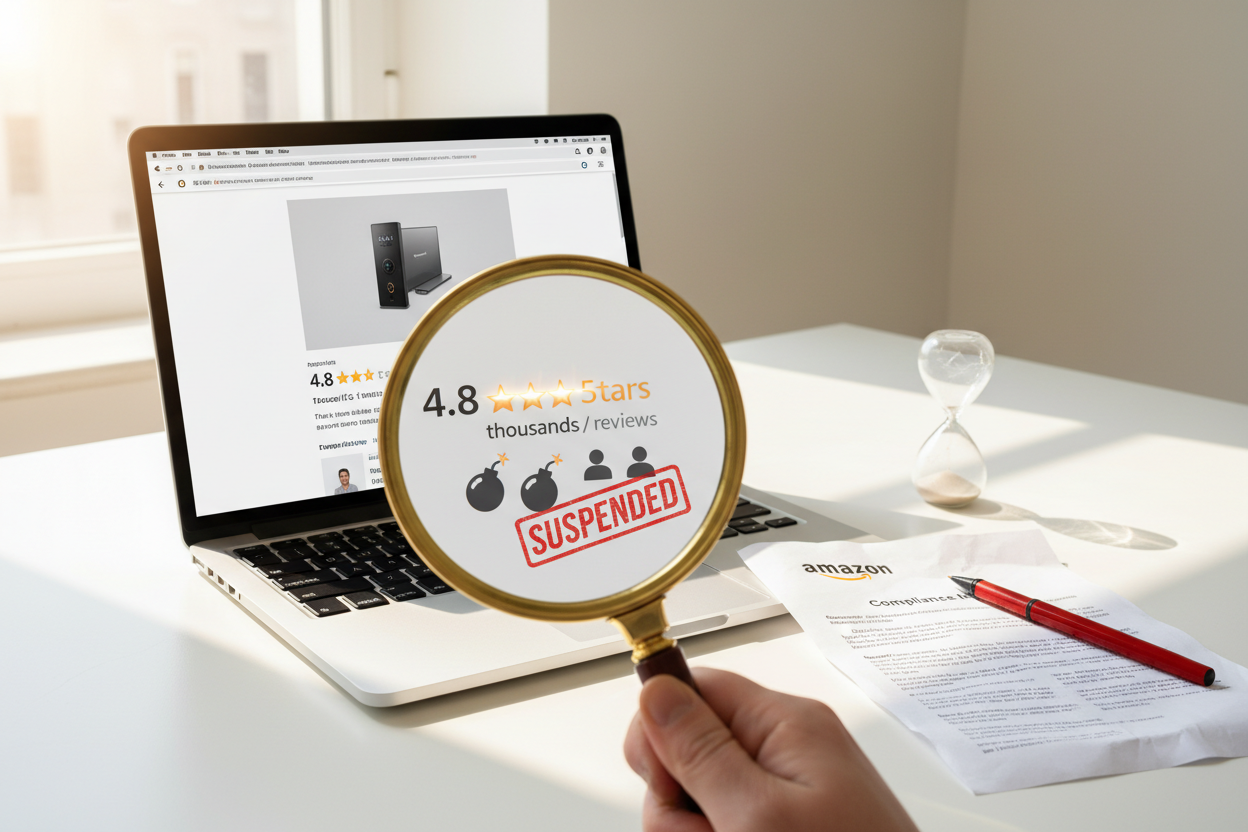
The Fake Review Time Bomb: Are You Inheriting a Suspended Amazon FBA Listing?
Bluf
Key Answer: Amazon FBA product reviews are not always safe just because the listing shows thousands of stars. If the seller used fake Amazon reviews, incentivized reviews, brushing, or old black-hat tactics, Amazon can remove those reviews or suspend the ASIN after you buy the business. To protect yourself, you must audit review velocity, review relevance, and third-party review quality before escrow closes. This is one of the biggest hidden risks when comparing amazon businesses for sale.
Here is the nightmare.
You buy a profitable Amazon FBA brand.
The product has a 4.8-star rating, thousands of reviews, strong conversion, and clean-looking profit numbers. Everything feels safe.
Then, 30 days after closing, Amazon sends the email no buyer wants to see: your ASIN has been suspended for review manipulation.
Overnight, reviews disappear. Conversion drops. PPC costs climb. Your inventory is stuck. Your capital is frozen. And the business you thought was stable suddenly becomes a compliance problem.
That is the fake review time bomb.
The technical truth is simple: reviews are not just social proof.
In Amazon FBA, reviews are part of the asset’s value.
If the reviews are fake, manipulated, or built through risky tactics, then the valuation is inflated. You are not buying real demand. You are buying a fragile illusion that Amazon can wipe out at any time.
This is what makes amazon businesses for sale so different from other models. If you buy an affiliate marketing business for sale, your risk is usually tied to SEO quality, backlinks, and traffic stability. If you buy a readymade dropshipping for sale asset, your biggest challenge is often traffic, supplier setup, and conversion. But with FBA, you are operating inside Amazon’s rules. If the previous seller broke those rules, the liability can follow the listing after the handover.

What sellers usually hide is how the first reviews were earned.
A listing with 2,000 reviews looks impressive, but the real question is how those reviews started.
Were the first 100 reviews earned naturally through real sales? Or did the seller use discount groups, incentivized reviews, fake buyer accounts, or brushing tactics to create momentum?
That early review history matters. If the foundation is dirty, the whole listing can become unstable. A broker may show you the current star rating, but that does not prove the review history is clean.
So before buying, run a strict three-part review audit.
First, run a velocity and vintage audit.
Use a tool like Keepa to compare review dates with sales rank and price history. If a product received a flood of five-star reviews during a period where sales volume was low, that is a red flag. Real review growth usually follows real demand.
Second, check for zombie listing or variant hijacking. Read the actual reviews. If people are talking about phone cases on a garlic press listing, or supplements on a fitness product listing, something is wrong. Black-hat sellers sometimes merge old listings with unrelated reviews to fake credibility.
Third, cross-check with tools like ReviewMeta or Fakespot. These tools are not perfect, but they can help flag unnatural phrasing, suspicious reviewer behavior, and fake-looking patterns. If the listing fails badly, do not ignore it. Walk away or renegotiate hard.

This is where many buyers overpay.
They value the business based on today’s conversion rate, but if that conversion rate depends on fake reviews, it may not survive after purchase.
Once Amazon removes reviews, your ad spend may need to rise just to maintain the same sales. If the violation is serious enough, the entire Seller Central account can be suspended.
That is not a small issue. That is capital destruction.
This is also why some investors prefer models where they control more of the infrastructure.
A verified ready-made online business for sale, or a clean Shopify-based asset where you own the domain and customer data, can reduce third-party suspension risk.
Choosing to buy turnkey shopify store under $100 is not about avoiding work. It is about starting with more control and less exposure to Amazon’s algorithmic enforcement.
EcomChief’s angle is straightforward. We do not want buyers walking into hidden platform risk. When reviewing FBA opportunities, you need to understand account history, review quality, traffic sources, supplier stability, and compliance risk. And when reviewing EcomChief assets, the goal is always the same: give buyers a cleaner, safer starting point with less technical uncertainty.

So before you buy, do not just ask, “How many reviews does it have?” Ask, “Can these reviews survive an Amazon audit?”
That one question can protect your capital.
If you want to explore vetted FBA opportunities, browse EcomChief’s Amazon FBA collection here: https://ecomchief.com/collections/amazon-fba-business-for-sale. And if you want a live example, check out this Amazon Health & Fitness FBA Business here: https://ecomchief.com/products/amazon-health-fitness-fba-business.
The smart move is simple: do not buy fake social proof. Buy clean demand, verified history, and a business that can survive after the handover.
Video recommendation
This video is relevant because it shows the visual warning signs of fake Amazon reviews, including suspicious review patterns and manipulated social proof.
It fits this article because buyers need to know what fake legitimacy looks like before they acquire an FBA listing and inherit its history.
Related reading
All articles


Free Online Business Calculators
Estimate costs, profits, ROI, affiliate earnings, and business value before you spend money.