
AiAgency
Stable Retainers vs. Project Revenue: How to Audit Agency Cash Flow
A big TTM revenue number can hide a dry pipeline. Here’s how to split retainers from project revenue, measure true MRR stability, and avoid buying a feast-and-famine agency.
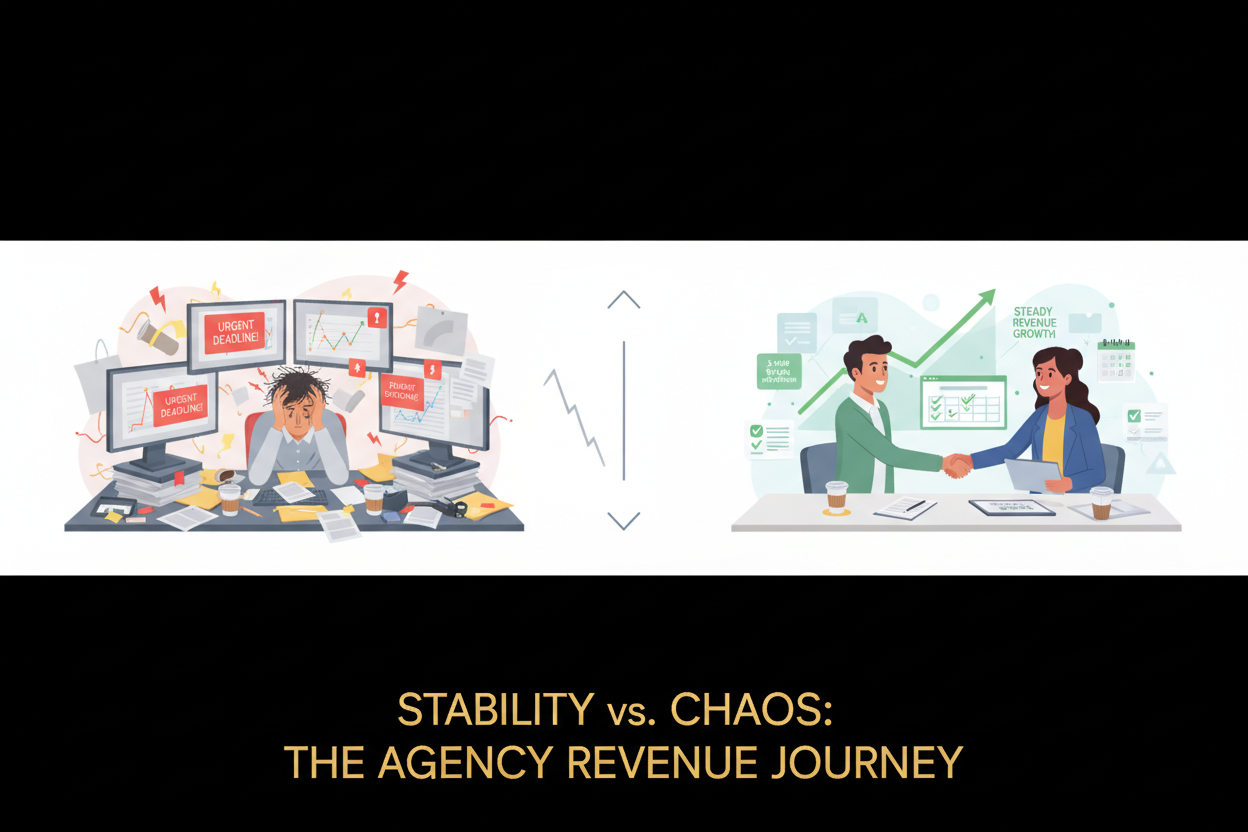
Stable Retainers vs. Project Revenue: Don’t Buy an Empty Pipeline
Key takeaway: A retainer-heavy agency is a different asset than a project-based agency. If the revenue does not repeat, you are buying a dry pipeline — not stable cash flow.
Let’s talk about one of the easiest ways to get fooled when buying an agency.
A seller shows you a beautiful Trailing 12-Month (TTM) revenue number — maybe $800,000 — and suddenly the business looks rock solid. The P&L looks clean. The story sounds great. And because the total revenue is high, they start pushing for a premium valuation multiple.
But here’s the technical truth, friend: revenue is not created equal.
A digital agency with stable retainers (MRR) is a very different asset from an agency surviving on a feast and famine project-based model. If most of the money came from one-off, non-recurring projects that already ended, then you’re not buying stable cash flow.
You’re buying a dry pipeline.
The “Feast and Famine” Fear
Verdict: TTM revenue can look strong while the future revenue pipeline is already empty.
Picture this.
You’re evaluating a digital marketing agency doing $800,000 in TTM revenue. At first glance, it looks like a machine. But when you dig into the client roster, you realize $600,000 of that came from just three huge website builds — and those projects wrapped up last month.
That changes everything.
Because now the real question is not “How much did the agency make last year?”
It’s “How much of that money is actually going to repeat?”
This is the fear serious buyers have: the seller is blending true Monthly Recurring Revenue (MRR) with one-off work to make the business look safer than it really is. On paper, it feels like momentum. In reality, it can be disappearing revenue.

The “Easy” Assets
Key takeaway: Branding and tools may transfer, but the real asset is revenue stability — and whether the business runs without a founder “genius” holding it together.
Some parts of the handover are straightforward.
The brand transfers. The domain and website move over. The marketing collateral, CRM, and sales scripts usually come with the deal. Even the contractor network often gets handed over too.
But here’s the catch: a contractor list is only helpful if the agency isn’t secretly being held together by one “genius with helpers” setup, where the founder still drives all the strategy and the team just follows behind. That’s exactly why this is an important companion read:
Buying an Agency: Don’t Fall for the “Genius with Helpers” Trap
It helps you spot whether the business is truly systemized or just founder-dependent with freelancers attached.
So yes, the visible assets transfer.
But the real asset is the stability of the cash flow.
The Hard Asset: True Monthly Recurring Revenue
Key takeaway: Sellers often blend retainers and projects into one big TTM number. Your job is to force the revenue to unbundle.
This is where sellers get slippery.
They know stable MRR commands a better valuation multiple than project work. So instead of separating the revenue clearly, they aggregate it all into one big TTM number and hope you don’t ask too many questions.
That’s the trap.
A $10,000/month SEO retainer that has stayed active for three years is far more valuable than a $10,000 website build that ends in 30 days. One gives you visibility. The other gives you stress.
When sellers blend those together, they’re not selling you next year’s security. They’re selling you last year’s wins.
And if the pipeline is already drying up, that big TTM revenue figure is just a backward-looking comfort blanket.
Why TTM Revenue Lies
Verdict: If most revenue was one-off work, you inherit the burden of replacing it immediately after closing.
This is where buyers get hurt.
They assume the revenue will continue automatically because the last 12 months looked strong. Then they take over and discover most of the income was tied to one-off projects that have already finished.
Now the business needs fresh work immediately.
That means you are thrown straight into new lead generation on day one. Not casually. Desperately.
And that sales cycle is rarely cheap or easy. It’s usually a high-pressure, expensive sales cycle that burns time and money fast.
It gets even worse if there’s concentration risk hiding underneath. If one giant client or one giant project was doing most of the heavy lifting, the business is even more fragile than it first appears. That’s why this fits naturally into the audit too:
Concentration Risk: The Hero SKU and Whale Client Trap Buyers Miss

The Protocol: How to Audit the Revenue Mix
Key takeaway: Force the revenue to separate into repeatable retainers vs. one-off projects, then value each stream differently.
If you want to protect your money, force the seller to unbundle the revenue.
Step 1: Split MRR from project revenue
Ask for a line-by-line revenue breakdown for the last 12 months.
Then color-code it:
- Green for contracted retainers active over six months
- Red for one-off builds, short campaigns, and non-recurring work
If the business is less than 70% green, you are looking at a risky feast-and-famine project-based model, not a stable retainer business.
Step 2: Check churn inside the “green”
Just because something is called a retainer doesn’t mean it behaves like one.
If clients sign for $2,000/month but most of them leave after month two, that is not true MRR. That’s just project revenue wearing a retainer costume.
Step 3: Apply the right valuation discount
If a large part of the agency relies on one-off work, you cannot pay a SaaS-style or MRR-style multiple for it.
That revenue deserves a steep discount, because after closing, you will carry the entire burden of replacing it.

Don’t Buy a Sales Cycle
Key takeaway: A high TTM number means little if the revenue disappears when projects end. Buy predictable retainers, not a constant chase.
This is the bottom line.
A high TTM number means very little if the revenue disappears the moment the last big project ends.
You don’t want to buy an agency only to discover you actually bought a stressful sales treadmill that constantly needs new deals just to stay alive.
What you want is predictable, contracted cash flow. Real retainers. Low churn. And a model where the business doesn’t go into panic mode every time a project wraps up.
At Ecom Chief, that’s why we look at the revenue architecture of agency listings — not just the headline revenue number. Because the goal is simple: help buyers step into predictable cash flow, not a dry pipeline dressed up as momentum.
If you want to explore better-structured opportunities, start with our Agency Businesses for Sale collection. And if you want a more specific example, the Digital Marketing Agency Business For Sale listing is a strong place to look at how retainer-based agency value should actually be assessed:
Digital Marketing Agency Business For Sale
So before you buy, ask the question that actually matters:
How much of this revenue is real, stable MRR — and how much of it disappears the moment the projects end?
Video recommendation
Verdict: Watch this while reviewing the seller’s revenue mix, and the difference between stable retainers and stressful project work becomes obvious.
This video is worth watching because it gets right to the heart of the problem: the difference between unpredictable project work and true recurring income. Watch it while reviewing the seller’s revenue mix, and it’ll become much easier to spot whether you’re buying stable retainers or just inheriting a stressful chase for the next deal.
Related reading
All articles


Free Online Business Calculators
Estimate costs, profits, ROI, affiliate earnings, and business value before you spend money.