
AmazonFBA
Shopify vs Amazon FBA: Which Business Should You Buy in 2026?
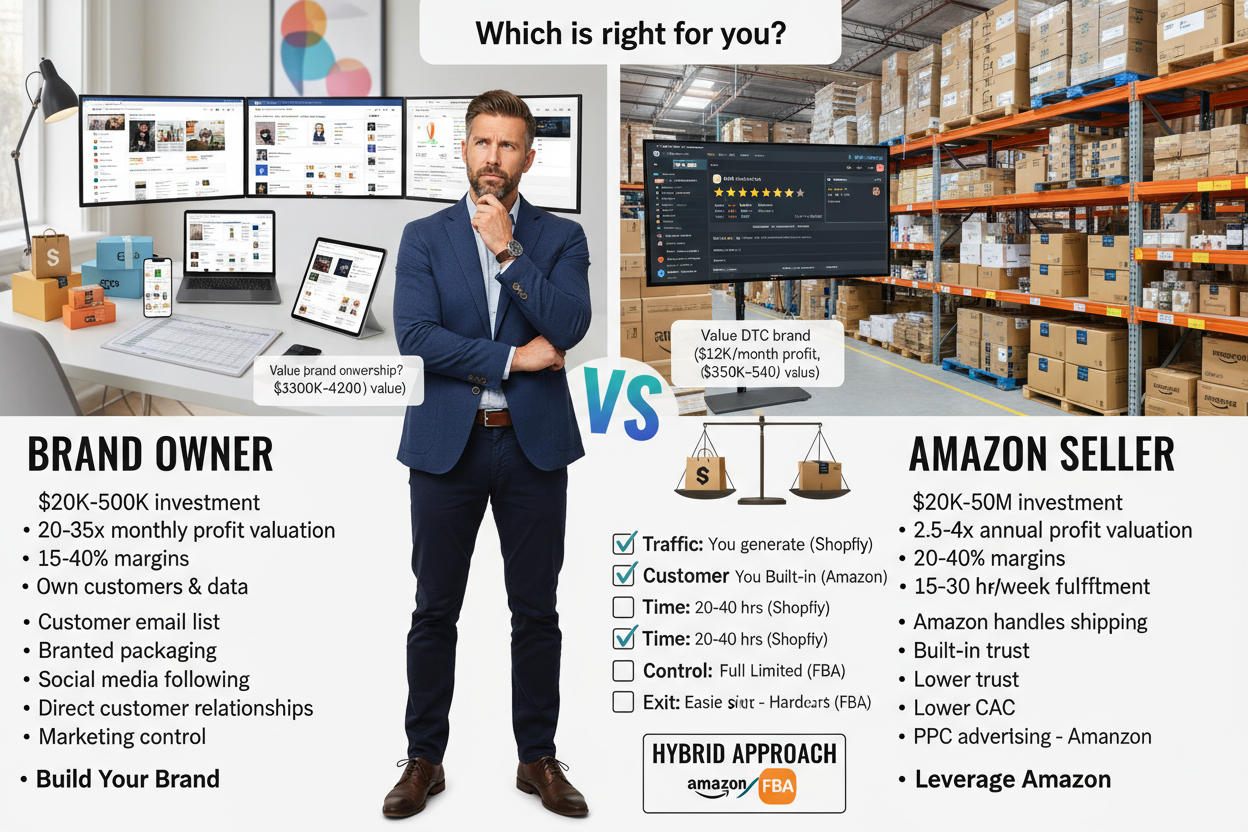
Choosing between buying a Shopify store or Amazon FBA business is one of the biggest decisions for aspiring ecommerce entrepreneurs in 2026. Both models offer proven paths to six-figure income, but they differ dramatically in investment requirements, profit margins, time commitment, and growth potential.
This comprehensive comparison reveals the key differences between Shopify stores and Amazon FBA businesses—helping you choose the right ecommerce model for your goals, budget, and lifestyle.
Quick Comparison Overview
Shopify Stores
Best for: Entrepreneurs who want brand control and direct customer relationships
Key characteristics:
- Investment: $20,000-$500,000
- Valuation: 20-35x monthly profit
- Profit margins: 15-40%
- Time commitment: 20-40 hours/week
- You own the customer relationship
- Full brand control
- Marketing required (ads, SEO, email)
Amazon FBA
Best for: Entrepreneurs who want built-in traffic and semi-passive income
Key characteristics:
- Investment: $50,000-$2,000,000+
- Valuation: 2.5-4x annual profit
- Profit margins: 20-40%
- Time commitment: 15-30 hours/week
- Amazon owns customer relationship
- Limited brand control
- Built-in traffic from Amazon
Detailed Comparison
Investment & Valuation
Shopify Stores:
- Valuation formula: Monthly profit × 20-35
- Example: $5,000/month profit = $100,000-$175,000
- Lower entry point ($20K-$100K for starter stores)
- No inventory required (dropshipping)
- Or inventory investment ($10K-$100K for DTC brands)
Amazon FBA:
- Valuation formula: Annual profit × 2.5-4
- Example: $150,000/year profit = $375,000-$600,000
- Higher entry point ($50K-$200K minimum)
- Inventory investment required ($10K-$100K+)
- Inventory typically included in purchase price
Winner for lower investment: Shopify (dropshipping stores start at $20K)
Winner for higher multiples: Shopify (20-35x vs 2.5-4x annual)
Profit Margins
Shopify Stores:
- Dropshipping: 15-25% net margins
- DTC brands: 25-40% net margins
- Print on demand: 20-30% net margins
- You control pricing completely
- No platform fees (just 2.9% + $0.30 payment processing)
Amazon FBA:
- Typical net margins: 20-35%
- Amazon fees: 15% referral fee + $3-$5 FBA fee per unit
- Total Amazon fees: 25-35% of sale price
- Less pricing control (competitive marketplace)
- Storage fees (monthly + long-term)
Winner: Shopify DTC brands (higher margins, lower fees)
Traffic & Customer Acquisition
Shopify Stores:
- You must generate all traffic yourself
- Paid ads: Facebook, Instagram, TikTok, Google ($2K-$20K/month)
- Organic: SEO, content marketing (takes 6-12 months)
- Email marketing: Build and own your list
- Social media: Build following from scratch
- Customer acquisition cost: $15-$50 per customer
Amazon FBA:
- Built-in traffic from 300+ million Amazon customers
- Amazon PPC ads (optional, $500-$5K/month)
- Organic rankings within Amazon
- No email list (Amazon owns customer)
- No social media needed
- Customer acquisition cost: $5-$20 per customer (lower)
Winner: Amazon FBA (built-in traffic, lower CAC)
Brand Control & Customer Relationships
Shopify Stores:
- ✅ You own customer email and data
- ✅ Full control over branding and messaging
- ✅ Direct customer relationships
- ✅ Can build email list and remarket
- ✅ Control entire customer experience
- ✅ Can sell anywhere (your site, Amazon, eBay, etc.)
Amazon FBA:
- ❌ Amazon owns customer relationship
- ❌ Limited branding (product listing only)
- ❌ Can't email customers directly
- ❌ Can't build email list from Amazon sales
- ❌ Amazon controls customer experience
- ❌ Locked into Amazon platform
Winner: Shopify (full brand control and customer ownership)
Time Commitment & Operations
Shopify Stores (Dropshipping):
- Time: 20-30 hours/week
- Daily: Process orders, customer service (2-3 hrs)
- Weekly: Ad management, email marketing (10-15 hrs)
- Monthly: Product research, strategy (5-10 hrs)
- More active management required
Shopify Stores (DTC Brand):
- Time: 30-40 hours/week
- Daily: Order fulfillment, customer service (3-5 hrs)
- Weekly: Marketing, inventory management (15-20 hrs)
- Monthly: Product development, strategy (10-15 hrs)
- Can hire team to reduce time
Amazon FBA:
- Time: 15-30 hours/week
- Daily: Check sales, answer questions (1-2 hrs)
- Weekly: Inventory management, PPC optimization (8-12 hrs)
- Monthly: Reordering, financials (5-10 hrs)
- More passive once systems in place
Winner: Amazon FBA (more passive, less time required)
Scalability
Shopify Stores:
- Scale by increasing ad spend (if ROAS is positive)
- Add new products easily
- Expand to new markets/countries
- Add new sales channels (Amazon, eBay, wholesale)
- Build email list for free traffic
- Unlimited growth potential
Amazon FBA:
- Scale by launching new products
- Expand to international Amazon marketplaces
- Limited by Amazon's rules and competition
- Inventory investment required to scale
- Can add Shopify store as additional channel
- Growth limited by Amazon platform
Winner: Shopify (more scalability options, not platform-dependent)
Risk Factors
Shopify Stores:
- ⚠️ Ad platform risk (Facebook/TikTok account bans)
- ⚠️ Must generate own traffic (no built-in customers)
- ⚠️ Supplier issues (dropshipping)
- ⚠️ Payment processor holds (Stripe, PayPal)
- ⚠️ Chargeback risk
- ⚠️ More moving parts to manage
Amazon FBA:
- ⚠️ Amazon suspension risk (account can be banned)
- ⚠️ Amazon owns customer (can't build email list)
- ⚠️ Amazon can change fees anytime
- ⚠️ Competitors can copy your product
- ⚠️ Amazon can compete with you (private label)
- ⚠️ Inventory risk (dead stock, storage fees)
Winner: Tie (both have significant platform risks)
Exit Strategy & Sellability
Shopify Stores:
- Easier to sell (more buyers for lower prices)
- Faster sale process (30-90 days)
- Valuation: 20-35x monthly profit
- Buyers like brand ownership and customer data
- Can sell on multiple marketplaces
Amazon FBA:
- Harder to sell (fewer buyers at higher prices)
- Longer sale process (60-120 days)
- Valuation: 2.5-4x annual profit
- Buyers concerned about Amazon dependency
- Specialized FBA marketplaces
Winner: Shopify (easier to sell, more buyers, faster process)
Side-by-Side Comparison
Shopify Dropshipping Store
Example business:
- Niche: Home organization products
- Monthly revenue: $25,000
- Monthly profit: $3,500 (14% margin)
- Valuation: $70,000-$105,000 (20-30x)
- Time: 25 hours/week
- Inventory: $0 (dropshipping)
Pros:
- ✅ Low entry cost ($70K-$105K)
- ✅ No inventory needed
- ✅ Own customer data
- ✅ Easy to sell
Cons:
- ❌ Lower margins (14%)
- ❌ Must manage ads
- ❌ Supplier dependency
- ❌ More active management
Shopify DTC Brand
Example business:
- Niche: Sustainable yoga gear
- Monthly revenue: $45,000
- Monthly profit: $12,000 (27% margin)
- Valuation: $300,000-$420,000 (25-35x)
- Time: 35 hours/week
- Inventory: $35,000
Pros:
- ✅ High margins (27%)
- ✅ Brand ownership
- ✅ Customer loyalty
- ✅ Email list asset
Cons:
- ❌ Higher investment ($300K-$420K + inventory)
- ❌ Inventory risk
- ❌ Must manage marketing
- ❌ More time intensive
Amazon FBA Business
Example business:
- Niche: Pet accessories (5 products)
- Monthly revenue: $42,000
- Annual revenue: $504,000
- Annual profit: $140,000 (28% margin)
- Valuation: $350,000-$560,000 (2.5-4x annual)
- Time: 20 hours/week
- Inventory: $45,000
Pros:
- ✅ Built-in traffic
- ✅ More passive (20 hrs/week)
- ✅ Good margins (28%)
- ✅ Amazon handles fulfillment
Cons:
- ❌ Higher investment ($350K-$560K + inventory)
- ❌ Amazon dependency
- ❌ No customer data
- ❌ Suspension risk
Which Should You Buy?
Buy a Shopify Store If:
- ✅ You want to build a brand (not just sell products)
- ✅ You want to own customer relationships and data
- ✅ You're comfortable with marketing and ads
- ✅ You have $20K-$500K to invest
- ✅ You want easier exit (more buyers, faster sale)
- ✅ You want full control over business
- ✅ You can commit 20-40 hours/week
- ✅ You want to build email list asset
Buy an Amazon FBA Business If:
- ✅ You want more passive income (15-30 hrs/week)
- ✅ You want built-in traffic (don't want to run ads)
- ✅ You have $50K-$2M to invest
- ✅ You're okay with Amazon owning customer
- ✅ You want Amazon to handle fulfillment
- ✅ You're comfortable with platform dependency
- ✅ You want proven product-market fit
- ✅ You prefer product focus over marketing
The Hybrid Approach (Best of Both)
Many successful entrepreneurs do both:
Strategy #1: Start with Amazon FBA, add Shopify later
- Buy Amazon FBA business first (built-in traffic)
- Once profitable, launch Shopify store for same products
- Drive Amazon customers to Shopify (inserts, packaging)
- Build email list from Shopify sales
- Diversify away from Amazon dependency
Strategy #2: Start with Shopify, expand to Amazon
- Buy Shopify store first (lower investment)
- Once profitable, list products on Amazon
- Use Amazon as additional sales channel
- Keep Shopify as primary brand home
- Benefit from both platforms
Benefits of hybrid approach:
- Diversified revenue (not dependent on one platform)
- Own customer data (Shopify) + built-in traffic (Amazon)
- Higher total revenue
- Lower risk (if one platform has issues)
- Best of both worlds
Real Examples
Example #1: Shopify Dropshipping Success
Purchase: $68,000 for home decor dropshipping store
- Monthly profit at purchase: $2,600
- Time commitment: 25 hours/week
After 12 months:
- Monthly profit: $6,200 (+138%)
- Business value: $155,000-$186,000 (+128-174%)
- Strategy: Scaled ads, improved conversion, expanded products
Example #2: Amazon FBA Success
Purchase: $420,000 for kitchen products FBA business
- Annual profit at purchase: $140,000
- Time commitment: 20 hours/week
After 12 months:
- Annual profit: $245,000 (+75%)
- Business value: $612,500-$980,000 (+46-133%)
- Strategy: Launched 3 new products, optimized PPC, improved listings
Example #3: Hybrid Approach Success
Purchase: $280,000 for Amazon FBA pet products business
- Annual profit at purchase: $95,000
After 6 months: Added Shopify store
- Shopify revenue: $8,000/month additional
- Shopify profit: $2,400/month additional
- Built email list: 3,500 subscribers
After 18 months:
- Amazon profit: $125,000/year
- Shopify profit: $42,000/year
- Total profit: $167,000/year (+76%)
- Business value: $417,500-$668,000 (+49-139%)
- Diversified revenue, owned customer data
Decision Framework
Choose Shopify If You Value:
- Brand ownership (most important to you)
- Customer data (want to build email list)
- Lower entry cost ($20K-$100K budget)
- Marketing skills (comfortable with ads)
- Full control (not platform-dependent)
Choose Amazon FBA If You Value:
- Passive income (most important to you)
- Built-in traffic (don't want to run ads)
- Proven model (less marketing required)
- Product focus (not marketing focus)
- Amazon fulfillment (hands-off shipping)
Consider Hybrid If You Want:
- Best of both worlds
- Diversified revenue (lower risk)
- Maximum growth (multiple channels)
- Long-term strategy (build empire)
- Higher total income (2 revenue streams)
Start Your Search
Both Shopify stores and Amazon FBA businesses offer proven paths to six-figure ecommerce income. The right choice depends on your goals, budget, skills, and lifestyle preferences.
Browse both business types and compare opportunities:
- Shopify Stores for Sale - Dropshipping, DTC brands, and ecommerce stores
- Amazon FBA Businesses for Sale - Private label brands and FBA businesses
- Browse All Businesses - Compare all ecommerce opportunities
Every listing on our online business marketplace includes verified financials, traffic data, and complete transparency—helping you make the right choice for your ecommerce journey.
Choose your path. Build your empire. Start today. Your ecommerce business is waiting.
Related reading
All articles


Free Online Business Calculators
Estimate costs, profits, ROI, affiliate earnings, and business value before you spend money.