
AiAgency
AI Agents for Business Are Becoming Infrastructure: What Salesforce + Anthropic Tell Entrepreneurs
Salesforce and Anthropic are connecting Claude to real business data, workflows and actions. Here is what that shift means for entrepreneurs building AI automation services.
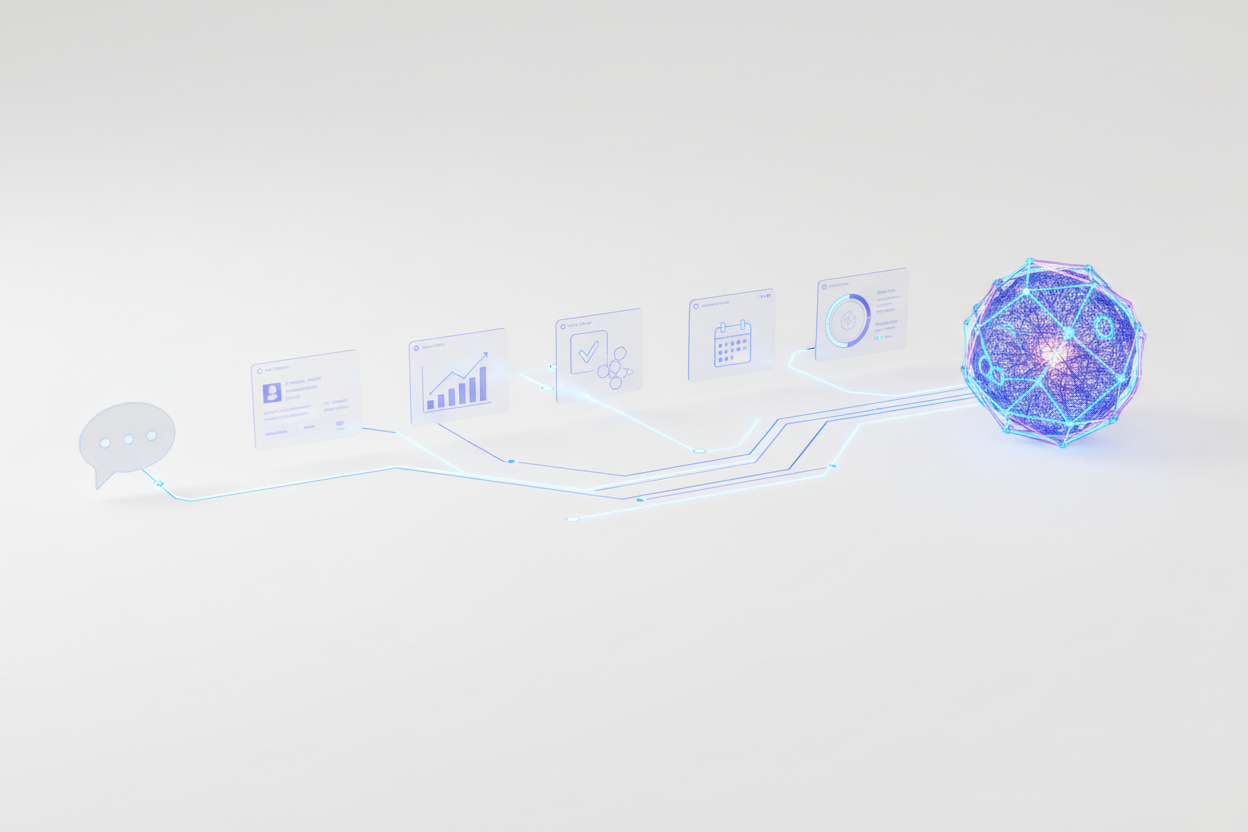
AI agents for business are moving beyond standalone chatbots toward systems that can access company data, understand context, follow business rules and take actions across real workflows. Salesforce and Anthropic's new Claudeforce partnership is a strong example: Claude can work with Salesforce data and sales workflows rather than simply answering questions. For entrepreneurs, that points toward an important opportunity—selling useful business automation outcomes instead of simply selling “AI.”
What This Means for You
If you are considering an AI business, the opportunity is becoming easier to define.
Businesses do not necessarily need another general-purpose chatbot. They need systems that can help complete specific work: qualify a lead, prepare a salesperson for a meeting, update a CRM record, route a support request, create a follow-up task or move information between systems.
That changes the potential role of an AI automation agency. Instead of selling vague promises about artificial intelligence, an agency can identify repetitive business processes and package automation around a specific operational result.
The important distinction is that AI does not remove the need for good processes, reliable data, permissions, testing or human oversight. The technology becomes more useful when it is connected to those things.
What Salesforce and Anthropic Actually Announced
In August 2026, Salesforce and Anthropic announced an expanded partnership called Claudeforce. Its first product, Salesforce in Claude, connects Claude with Salesforce's business data, workflows, rules and actions.
According to Salesforce's announcement, Salesforce in Claude launches with 37 prebuilt sales skills. Examples include meeting preparation, deal-health review and pipeline review.
The important part is not the number of skills. It is what those skills demonstrate.
- Claude can reason over current business context.
- The AI can work with information stored in a CRM.
- It can interact with existing workflows rather than operating separately from them.
- Actions can remain subject to Salesforce permissions and business rules.
- The AI interface can become another way of operating business software.
Salesforce also supports connections through Model Context Protocol, or MCP. In simple terms, MCP provides a standardized way for compatible AI applications to connect with external systems and approved tools. Salesforce's Hosted MCP Server documentation explains that compatible AI clients can interact with Salesforce data and automation while operating within Salesforce permissions and governance.

Why This Is Different From a Traditional AI Chatbot
A traditional chatbot is mainly conversational. Someone asks a question and the chatbot generates a response.
An AI agent becomes more useful when it can combine conversation with access to approved information and tools.
| Capability | Basic chatbot | Connected AI agent |
|---|---|---|
| Answer questions | Yes | Yes |
| Use live business context | Limited or none | Possible when connected |
| Update business systems | Usually no | Possible through approved tools |
| Trigger workflows | Usually no | Possible |
| Follow company permissions | Depends on implementation | Can be designed around existing controls |
| Complete multi-step tasks | Limited | Potentially, within defined boundaries |
This distinction matters commercially because businesses generally buy solutions to operational problems, not technology terminology.
A company may not care whether a system uses an autonomous AI agent, a workflow platform, an API or several tools together. It cares whether the resulting system solves a useful problem reliably.
Where AI Automation Agencies Can Fit Into This Shift
The Salesforce and Anthropic example involves enterprise sales infrastructure, but the underlying model can be applied much more broadly.
An AI automation agency can look for repetitive processes where information arrives, a decision needs to be made and a predictable action follows.
Examples include:
- Lead qualification: collect information, classify the enquiry, route the prospect and update the CRM.
- Sales preparation: summarize account information, recent communication and outstanding tasks before a sales call.
- Customer support: categorize incoming requests, answer approved routine questions and escalate exceptions.
- Client onboarding: collect required information, create tasks, send instructions and alert the appropriate team member.
- Follow-up workflows: identify an unfinished process and create or send the next approved action.
- Reporting: gather information from approved systems, summarize it and create follow-up tasks for a human user.
None of these should be sold as guaranteed revenue generators. Their value depends on the client's existing process, data quality, software, implementation and how the automation is managed.
The EcomChief Agent Opportunity Filter
Before proposing an AI agent, evaluate the workflow itself. EcomChief's simple Agent Opportunity Filter scores a process across five questions.
| Question | 0 points | 1 point | 2 points |
|---|---|---|---|
| Does the process repeat? | Rarely | Sometimes | Frequently |
| Is the required information accessible? | Mostly unavailable | Partially available | Structured and accessible |
| Is there a clear next action? | Highly subjective | Partly defined | Clearly defined |
| Can the result be measured? | No clear measure | Indirect measure | Clear operational measure |
| Can exceptions be escalated safely? | No | With difficulty | Yes |
A score of 8–10 suggests a strong candidate for further investigation. A score of 5–7 may justify a limited pilot. A score below 5 usually means the process should be clarified before adding AI.
This is a decision framework, not a guarantee that automation will succeed. Technical feasibility, privacy requirements, platform permissions and implementation costs still need to be checked.

Considering building a service business around these types of workflows? You can explore EcomChief's ready-made AI Automation Agency as a starting business asset. It provides an agency foundation; client acquisition, service scoping and business growth remain the owner's responsibility.
Sell the Outcome, Not the Phrase “AI Agent”
One of the clearest commercial lessons from this shift is positioning.
Compare these two offers:
Technology-led offer: “We build autonomous AI agents.”
Outcome-led offer: “We build a lead follow-up system that qualifies enquiries, updates your CRM and routes high-priority prospects to your sales team.”
The second version explains what the client is actually buying.
The same approach can be used across different services:
- Instead of “AI customer-service agent,” sell faster first-line support with defined escalation rules.
- Instead of “AI sales agent,” sell lead research, meeting preparation or structured CRM follow-up.
- Instead of “AI workflow automation,” sell a specific onboarding, reporting or administration process.
- Instead of “no-code AI agent,” explain the business task that is being simplified.
This also makes an agency easier to differentiate. Two agencies may use similar underlying software while solving completely different business problems.
AI Agents Are Not Autonomous Employees
The term “autonomous” can create the wrong expectation.
Giving an AI system access to business tools does not mean every process should run without supervision. Some decisions involve money, sensitive information, contractual commitments, customer relationships or actions that are difficult to reverse.
A safer automation design asks:
- What information can the agent read?
- What actions can it take?
- Which actions require human approval?
- What happens when confidence is low?
- How is activity logged?
- How can a person stop or correct the workflow?
Salesforce's approach is useful here because actions can be routed through existing Salesforce permissions and business rules rather than giving an AI unrestricted access to every system.
For an AI automation agency, governance is therefore part of the service—not an optional technical detail.
A Practical AI-Agent Launch Sequence for Entrepreneurs
You do not need to begin by building a complicated general-purpose agent. A narrower approach is often easier to explain, demonstrate and test.
- Choose one customer type. For example, property companies, agencies, professional services businesses or ecommerce operators.
- Identify one repetitive workflow. Look for a process involving repeated information, decisions and follow-up actions.
- Map the systems involved. Identify the CRM, inbox, spreadsheet, booking system, help desk or other software involved.
- Define the permitted actions. Decide what the system can do automatically and where approval is required.
- Create a narrow demonstration. Show one useful workflow working from beginning to end rather than demonstrating dozens of disconnected AI features.
- Package the service around the result. Describe the business process being improved rather than leading with technical jargon.
- Measure the workflow. Agree on operational measures that make sense for that specific process.
This approach also makes it easier to decide when AI is unnecessary. If a normal rule-based automation can perform the task reliably, there may be no reason to add an AI model.

Why This Matters for the AI Automation Agency Model
The bigger opportunity is not simply that more companies are adding AI.
The important change is that AI is increasingly being connected to the systems where actual business work happens.
That creates a practical role for agencies that can sit between the technology and the business problem.
The agency owner's responsibilities may include:
- understanding the client's workflow;
- identifying suitable automation opportunities;
- defining requirements and permissions;
- coordinating technical implementation;
- testing the workflow;
- training users;
- monitoring problems and exceptions; and
- improving the system as the client's process changes.
Technical implementation can sometimes involve no-code tools, APIs, MCP connections, specialist developers or a combination of methods. “No-code” does not mean “no expertise,” and an agency should never promise a particular integration before confirming that the relevant systems support it.
If you are evaluating this type of business model, EcomChief also provides a broader collection of ready-made agency businesses, together with information explaining what is included with EcomChief business assets and the ownership and handover process.
The Bigger Signal From Salesforce and Anthropic
The Salesforce and Anthropic partnership should not be interpreted as proof that every company now needs an AI agent or that every AI automation business will succeed.
It does, however, demonstrate an important direction: AI systems are becoming more useful when they can work with real business context, approved data, workflows and actions.
For entrepreneurs, that changes the question from “What can AI generate?” to “What useful business process can AI help complete?”
That is a much stronger foundation for an AI service business.
If you want to build around this model without beginning with a blank website and brand, explore the EcomChief AI Automation Agency. Treat it as the starting infrastructure for your agency—not a guarantee of customers, revenue or business performance.
Related reading
All articles


Free Online Business Calculators
Estimate costs, profits, ROI, affiliate earnings, and business value before you spend money.